Social Book

  • Subscribe to our RSS feed.
  • Twitter
  • StumbleUpon
  • Reddit
  • Facebook
  • Digg
Showing posts with label Facebook. Show all posts

Sunday, 13 October 2013

Social Media Secrets for Authors, Part IV: How Not to Spam

Posted on 09:55 by Unknown

If you've ever wondered why unsolicited Internet advertising is named after a perfectly innocent meat product, blame Monty Python. In a famous 1970 sketch, the customers in a café are constantly drowned out by a chorus of Vikings singing "Spam, Spam, Spam, Spam... Lovely Spam! Wonderful Spam!" Conversation is impossible because of the "spammers."

Spam-mobile photo via Wikicommons

But whatever it's called, we don't want to generate it.

This is because:
  • It's annoying. 
  • When you annoy people, they might remember you, but not in a good way.
  • It wastes time and energy you could be putting into your writing.
  • Vigilante groups can be cruel in enforcing anti-spam rules.
As I've said before, social media is social. It should not be used for direct marketing. For more in my "Social Media Secrets" here are links to Part 1: How to Avoid Twitter-Fritter and Facebook Fail, Part 2: How to Blog Your Way Out of the Slush Pile,  and Part 3: What Should an Author Blog About?

Here's the "secret" about social media that marketers don't tell you: it should be used for making friends, not direct sales.

As I keep saying, you wouldn't wear an advertising sandwich board to a Chamber of Commerce mixer, but a lot of authors are doing the digital equivalent.

  • An ideal use of social media is when a digital friend picks up your new book because she loves your genre and she's watched you agonize over getting a publisher or struggle through all the hoops of self-publishing. Then she tells all her friends how the book made her laugh/cry/escape when she was going through her recent crisis. You connect emotionally with people, which is why your book takes on meaning for them.
  • A bad use of social media is when people go to follow you on Twitter and find nothing but a stream of identical tweets saying "buy this book"...and nothing to suggest you're anything but a self-involved artificial life form. 
  • Or they visit your blog and it has nothing but posts bragging about how everybody loves you and your books and you're just so doggone...full of yourself! Yes, it's possible to spam your own blog. Don't do it. 
But it's not always so easy to tell if you're spamming. What is the line between "savvy marketing" and spam?

Truth is: the rules can be different for each site. But finding them can require tech savvy and knowledge of legalese (and good eyesight: they're usually written in a flyspeck font.)

Here are the rules I've managed to discover, mostly by breaking them. As Ruth and I say, we make the mistakes so you don't have to.

How not to Spam on Facebook

1) Don't link to your blog or website from anything but your own page or a designated thread. Links to your blog or website are considered spam on Facebook, no matter how useful. They'll put you in Facebook jail (freeze you out of your own page) if you post links to your blog more than a few times a week, even in a private group.

This happened to me. Somebody in a group asks at least once a week about using song lyrics in fiction. So I used to post a link to our guest blog piece from Michael Murphy that tells you how to get rights to song lyrics .

But I was wrong on that. Unwritten Facebook rules say you can't do that, and a self-appointed vigilante will click the "report for spam" button and you're off Facebook for a week or more and your blog is flagged forever as "spam." Much hoop-jumping is required to get reinstated. Don't take the chance.

2) But Facebook has NO problem with links to your buy page on Amazon or other retail sites. So it's fine to put "buy my book" posts on as many Facebook pages as you like. Just make sure they're promotion sites like Canadian Free and Promoted Books, Authors 99c E-Book Promotion , or Free Books 4 U and follow site guidelines.

3) Don't friend more than a few people a day. Even though Facebook is constantly hounding you to "friend" people, it's a trap. If you actually do what they say, you'll end up in Facebook jail.

4) Don't post a promotion of your book in a group without reading the rules first. Many groups will kick you out for it.

5) Posting promos on somebody else's Facebook page is serious spam. It's a violation of personal space. Nothing will make people unfriend you faster. It's like posting a billboard on somebody's lawn without permission.

6) Never market through a FB direct message. If you're not friends with the person, it will go in the "other" folder with all the proposals of marriage from men with poor English skills and a photo they stole from some CEO's bio page. which means they're not likely to see it anyway. And besides, it's rude. Never use personal messaging for advertising. A direct message is like a phone call. Do you like getting unsolicited "cold calls" from marketers? Yeah. Nobody else does, either.

7) Never add somebody to a group without permission. There's been a trend to add random people to book launch "parties" and other "love my book" groups. Your targets will start to get dozens of notifications about you and your book which will be unwanted 99% of the time. Facebook won't punish you for it, but you're likely to get unfriended. And lose possible sales. Thanks, Tymber Dalton for the addition.

How not to Spam on Twitter

1) Never send those automated direct messages that say, "Now that you've followed me, go like my Facebook and author pages, follow my blog, buy my book and pick up my dry cleaning, minion! Mwahahah."

They're against the Terms of Service as well as causing an auto-unfollow from practically everybody. For more on why not to use automatic direct messaging, here's a great post from social media consultant Rachel Thompson: Death to the Auto-DM on Twitter.

2) Do NOT send direct messages to people you don't have a relationship with. Not even to say "thanks for the follow." A follow is not a relationship. If you must thank for a follow, sent it in a @Tweet. (Not an automated one.)

3) Don't tweet your book more than a few times a week unless you have news like a great review or a sale or freebie run. Otherwise, it's just noise that gets ignored.

4) Don't tweet somebody else's book link just because they ask. Make sure it's in a genre your Tweeps will enjoy. (DO hit the button that says "I just bought [title] by [author] on Amazon when you buy a book. That's a great way to recommend it.)

How not to Spam on Amazon

1) A link to your own book in a review is spam. It can get you banned from Amazon. You can have a title in your signature and post as "Susie Scrivener, author of Scribblings," but without a link.

2) Do not mention your book in the Amazon Forums. Better yet, don't go there. It's troll habitat and very anti-author.

3) Link to your blog ONLY in a designated thread in Kindleboard forums, even if your blog is full of useful information to writers. I learned that the hard way.

How not to Spam on Blogs

1) Never, ever subscribe to a blogger's newsletter just so you can hit "reply" and send an ad for your book. It's happened to me a couple of times. It's insulting and pointless. The ad doesn’t go to the mailing list. It goes to the blogger—who will put you on their list of authors to avoid, especially if the genre has nothing to do with the blogger's interests. Remember this is about making friends, not enemies.

2) Don't link to your buy page from a blog comment. I don't mind links to a blog or webpage—in fact I find them useful—but some people don't like links of any kind from a blog comment, and they'll delete the comment as spam, so be wary.

3) Don't talk up your book or blog in a comment unless it's relevant to the conversation.
  • "I respect your opinion on prologues, but I've got testimonials from readers who love prologues—the longer the better—over at my blog today" is fine. 
  • "This discussion of Marcel Proust reminds me of my book, Fangs for the Memories, a zombipocolyptic vampire erotic romance, $3.99 on Smashwords." Not so much.
How not to Spam on Forums

1) Lurk. Every forum is different. So never say anything in a forum until you've unearthed every rule and hung out for a good long time.

2) Beware "share" buttons. I made the mistake earlier this year of sending out my blog link to a number of sites via the "share" button Blogger provides. This apparently sent it to forums where it should not have gone on Reddit, StumbleUpon and Digg. A nice moderator from Reddit informed me all my posts had been deleted as spam.

3) Better yet, stay out of book-related forums altogether, except small, well moderated, author-friendly ones like Nathan Bransford's, Red Room, She Writes, Critique Circle, or Kristen Lamb's WANAtribe. The bigger and older the site, the more likely it will have resident trolls, bad-tempered vigilantes and anti-author groups.

How not to Spam on Goodreads


1) Don't join a group just to promote your book. Spend a long time talking about other books before you bring up your own. In fact, on Goodreads, it's best not to mention you're an author at all. Take off your author hat and discuss books you've read, not ones you've written.

2) Don't send mass friend requests. This is true on almost all sites. You will be flagged as a spammer.

3) Don't thank a reviewer or someone who has put your book on their "shelf." The new Goodreads author guidelines prohibit it.

4) And especially: never, ever, ever engage with somebody who has given you a bad review or put you on a hate "shelf." Not for any reason. Goodreads reviews are notoriously unpleasant, unhelpful, and snarky. But authors need to learn to live with them.

How not to Spam on Google+


I don't have a clue. Seriously. Google+ is mostly a mystery to me. So far I've observed that each group has its own rules, and people are remarkably polite.

Users seem to be techies and business-people who are too busy making a living to engage in childish behavior.

There has been a kerfluffle in the tech world this week because Google+ has changed its TOS and is going over to the dark side, and wants to invade your privacy like Facebook, and may even use your comments and profile pictures to promote products. But there is a way to opt out through this link.

Next week we're going to have a guest post from Google+ guru Johnny Base, who's going to tell us everything an author needs to know about Google+

What about you, scriveners? Have you ever been criticized or punished for spamming when you didn't realize you'd broken the rules? What kind of spam bothers you the most? Do you think spam marketing sells books? 


Book Bargain of the Week

NOW AVAILABLE ON NOOK!! 
Sale extended! No Place Like Home is back to 99c this month since being chosen as "Book of the Month" by the BoomerLit group. Still only on Amazon US, Amazon UK, and Amazon CA ,


"A warp-speed, lighthearted comedy-mystery"...Abigail Padgett
"A fun, charming novel about the rich and less so" ...Karen Doering
"A cross of dry British humor and American wackiness, and it all adds up to a fun read." ...Deborah Bayles

Opportunity Alerts

Writers Conference Alert! The James River Writers Conference returns to Richmond, VA on October 19 and 20 with an extensive lineup of big name agents, authors and literary professionals. They're featuring award-winning book designer and writer Chip Kidd, National Book Award-winner Kathryn Erskine and best-selling author Christopher McDougall. Literary Publicity Firm JKSCommunications, Book Doctors and Pitchapalooza founders Arielle Eckstut and David Henry Sterry will be on hand for advice. You can pitch to agents including April Eberhardt, Deborah Grosvenor, Victoria Skurnick and Paige Wheeler. For details and registration, JamesRiverWriters.org

EBUK Bargains UK now has a blog! Get all the most up to-date info on the international book marketing scene from the guys who wrote one of our most popular guest blogposts ever.

The Sherwood Anderson Fiction Award from the Mid-American Review. $10 entry fee for a story up to 6000 words. First Prize: $1,000 and publication. Four Finalists: Notation, possible publication. You may submit online or snail mail. Details at website. Deadline is November 1, 2013.

J.F. POWER PRIZE FOR SHORT FICTION
  NO ENTRY FEE. The winner will receive $500. The winning story will be announced in February, 2014 and published in Dappled Things, along with nine honorable mentions. The word limit is 8,000 words. Deadline is November 29, 2013. 

MYSTERY AUTHORS! The Poisoned Pen Press, one of the most prestigious small presses, is open for submissions for one month. They open for submissions twice yearly, once during the month of October, and once during the spring. During October, they will accept submissions for regular publication. During the spring submissions period they open for the Discover Mystery first book contest. Please note their entire submissions process is electronic via the online submissions manager, Submittable. Mailed or e-mailed submissions will not be read. They will be accepting regular submissions during the period between October 1 and October 31. 
Read More
Posted in Book Marketing, Facebook, Goodreads, Google+, How not to spam, How to stay safe online, Rachel Thompson, social media etiquette, social media for authors, Twitter | No comments

Sunday, 6 October 2013

The Laws of the (Amazon) Jungle—Eight Rules Authors Need to Know to Stay Safe

Posted on 10:02 by Unknown
Update: This is probably now the longest blogpost in history, so I apologize. But I've had important updates from commenters that I'm incorporating into the post. An intellectual property lawyer has enlightened me on a lot of things I had wrong. (Scroll down to Rule #5). And South African romance writer Niki Savage has an update on Amazon's rules for reviewing authors in your own genre (Rule #2) Thanks for all the helpful comments!

Everybody tells authors we must use social media to have successful careers in the E-age, but nobody talks much about the dangers that lurk here.

Here's the thing: the Internet is still the wild frontier. And it's so huge nobody's quite sure how to police it.  Big, loosely regulated social media sites seem to encourage the worst in human behavior. Facebook allows people to make hate pages for celebrities with happy abandon, and the comments on news sites and You Tube can make you want to wash your eyeballs.

You Tube is making some sweeping changes to try to curb some of the more horrifying comments. You'll soon need a Google+ account to log in. (Google+ is set to become the most important player for business in social media. We'll have a post on that in a few weeks.)

Online nastiness is so pervasive that even some literary sites have become more like a jungle full of feces-throwing monkeys than a place for civilized discourse.

Recently, the review site Goodreads (now owned by Amazon) has tried to cut down on the poop-tossing by deleting some ad hominem attack "reviews" and obscene or threatening "shelf" names. Some people decry this as censorship and are protesting by sabotaging Goodreads with thousands of one-star "reviews" on random authors' books.

You can read an overview of the new developments by Pavarti K. Tyler at Indie Reader and Laura Hazard Owen at Gigaom and more at the Passive Voice.

But I fear it will take more than deleting a few reviews to change the online culture of entitlement and emotional brutality.

After I wrote my post on "Gangs of New Media" a few months ago, people contacted me with heartbreaking tales of online bullying in the publishing industry. Authors, readers, and reviewers alike had horror stories.

Respected reviewers had stopped posting to Amazon because of reviewer-on-reviewer attacks and harassment by angry authors. A seasoned Hollywood screenwriter was hounded so mercilessly she had to unpublish her books and change her name. Even a retired army sergeant has been terrified into silence.

But Amazon is trying to crack down, and you can help by reporting abuse when you see it.

Meanwhile, writers need to learn how to avoid gang-infested neighborhoods and stay off the radar of the poop-tossers, bullies, and vigilantes.

Unfortunately marketers sometimes tell us to go into those neighborhoods and do the very things that will set off attacks. I've seen "marketing handbooks" that are the equivalent of sending children into gangland wearing a rival gang's colors.

Part of the problem is that the rules of the online book world bear little resemblance to the conventions of the staid, gentlemanly publishing industry of the past.

That's because the laws of online activity come from the people who were here first: hackers and gamers.

When you enter the online culture, it can feel like stepping into a game of "Grand Theft Auto." It's an aggressive, testosterone-fueled, competitive universe. On some sites, sociopathic behavior is the norm and innocence is a crime.

Everybody is trying to eliminate the enemy, and the enemy is probably you.

"Gaming the system" is a matter of pride for some, and because people tend to judge others' characters by their own, the system-gamers think every innocent newbie is gaming the system too. (If someone accuses everybody he meets of sneaky, underhanded dealings, he's revealing a lot about himself.)

Probably the most infamous Internet menace was the sociopath called Violentacrez, who slimed up the forums of Reddit with threats and hate speech masked as "categories" with names like "chokeabitch" that were technically within site guidelines, but invited misogynist rants, child pornography and hate.

We can't blame the Internet entirely for the phenomenon. These are the same people who 40 years ago would name their dogs a racial slur and claim to be "just calling the dog." If anybody objected, they'd rally a mob to beat up the "puppy hater."

Violentacrez was finally outed by Gawker last year, but thousands of his trollish kin remain—and plenty of them lurk under literary bridges.

So don't give them an excuse to terrorize you. Follow the rules. Nobody deserves to be bullied, but you're safer if the bullies don't notice you.

Remember: social media should not be used for direct marketing. It should be used for making friends. You wouldn't wear an advertising sandwich board to a Chamber of Commerce mixer, but a lot of authors are doing the digital equivalent. It makes them bully-bait.

If the bullies catch you breaking their rules—even unwritten ones—they will destroy your career and reputation with all the self-righteous sadism of the Taliban slaughtering a schoolgirl.

Unfortunately, ferreting out those rules can be daunting. Even when they're posted, they're usually obfuscated by legal jargon written in a fly-speck font. I've only learned the following by trial and error. Lots of error. When I wrote this post urging older people to learn to write Amazon reviews, I was pretty naive. I still urge readers of my generation to write reviews—this is a culture desperately in need of grown-ups—but if I'd known about the hostility of the review culture, I would have worded it more carefully.

Since then, I've been saying, "I wish somebody would post the rules!"

But hey, nobody has, so here they are—as well as I can figure out. Pass them on to your marketing department.

Rule #1 Never Spam 


Easy to say; harder to follow.

What is spam? It's unwanted promotion: the digital equivalent of those sales pitch phone calls you get just as you're sitting down to a family dinner.

But one person's spam is another person's "savvy marketing." One of our biggest problems is that spam is defined differently depending on where you are.

Here's a detailed post on how NOT to spam on specific sites like Facebook, Twitter, Goodreads, forums, etc.

A few authors have spammed and gamed the system so badly that we're all paying the price.

Some readers have reacted so negatively they've invented a bizarre dichotomy of readers vs. writers. They consider anybody who writes to be the mortal enemy of "readers." Don't ask me where they think reading material comes from. A Magical Book Stork in the Sky may be involved.

Of course, in real life, authors are voracious readers, but remember this is a videogame world, so they need an enemy.

Mention you've written a book—even an unpublished one—and that enemy is you.

Rule #2: Never Trade Reviews


It's against Amazon's terms of service. A violation can get you kicked off Amazon. It will certainly get your reviews pulled if you're caught.

One of the tricks of the early Amazon-gaming authors was to give a book a 5-star review, then contact the reviewed author and demand a 5-star in return. If the targeted author refused, the 5-star would be reduced to a one-star.

Not all trading of reviews is the result of blackmail. Lots of authors drop hints they expect a quid pro quo when they've written a good review. Do not fall into this trap. Even if you love the reviewer's book, you could be violating Amazon's TOS.

One of Amazon's rules is that you can't review a product if you will benefit from the proceeds. That's why your Mom can't give you a review. Or your editor. You also can't review if you have a "rival" product. This has been interpreted recently to mean "any author who writes in the same genre"—even if that review is positive.  I think that's silly, but it's best to be safe.

In the great Amazon review purge following the purchased-review scandal of 2012, thousands of reviews were removed, some of which were solid, honest reviews, so you need to avoid any hint of impropriety. If you love the book of an author in your genre who has given you a nice review, and you want to avoid any worries, give her a spotlight or interview on your blog or offer a blurb to be included in the "editorial reviews" instead of appearing to trade.

Update: South African author Niki Savage reports that an Amazon spokesperson told her the Zon has revoked the rule that authors can't review other authors in their genre! I don't know if this applies to the Zon worldwide, but if you've been dying to review a book in your favorite genre, go for it!

Rule #3: Don't Pay for Customer Reviews 


As I mentioned above, buying reviews is a major no-no. Not only will they be removed, but your career can take a big hit. When John Locke got caught doing it a year ago, he got hit with hundreds of one-stars and his sales slowed considerably. 

It's OK to pay for a professional review from Kirkus, Publisher's Weekly, or other respected publication like the Midwest Book Review. But those reviews can't be posted on Amazon as "customer reviews." You can paste a quote into the "editorial reviews" section. But a customer review is not supposed to be for sale. 

Even a free book is considered "payment" by some, so book review bloggers are now required to post disclaimers when they review a book they have received from the author or publisher, although free review copies have always been a standard practice in the industry.

(Recently a blogpost was circulating that accused pretty much every major indie author of purchasing 500+ book reviews from Fivrr. This was a nasty hoax. Some of the authors accused don't even have 500 reviews on all their books combined.)

Rule #4 Never Respond to Your Reviews


If a review violates the rules, you can ask for it to be removed, but responding—even to a good review—makes some reviewers nervous. They want to feel we're off in another realm somewhere, not right here looking over their shoulders.

On places like Goodreads, people will call you a "badly behaving author" simply for thanking a thoughtful reviewer for a good review.

What you can do when you get a fantastic review is follow the reviewer on other social media and hope they'll initiate contact. Several of my reviewers have become good friends because I friended them on Facebook. But resist the urge to say "thank you" in the comments of the review itself. I did this myself before I knew the rules, with no bad consequences, but you never know when a vigilante might be lurking. (I'm only talking about review sites here: not blogs. Most bloggers welcome a thank-you for a nice review.)

But especially don't comment on nasty reviews. You're inviting more abuse.

Here are a few facts about reviews that may help to keep your fingers off the keyboard when the nasties hit:

1) Online review sites do not require reviewers to read a book and often allow people to rate a product even before it's available to anyone. This is a convention of the gaming world. It's something videogame companies did in the early days to gauge interest in a new game. Now, unfortunately, it's become a convention in online bookselling.

There's nothing we can do but spread the word that those star ratings don't mean a thing. I wish they'd drop them.

Why do people write nasty, hateful reviews of books they haven't read? Because being nasty and hateful is what they do. A new study says haters really gotta hate. Be glad they're on your book page and not in your living room.

2) One of the most common nasties is the "I hate this genre" review. I've seen plenty of review pages by people who apparently do nothing but troll Amazon for books in genres they hate so they can write one star reviews. Unfortunately, they have that right. 

3) Bestsellers pretty much always get snarky reviews. So accept it as a mark of success. Sometimes they're from sour-grape wannabes and sometimes from sock puppets. (Those are other authors with fake id's trying to get you "out of the way.") But sock puppetry is hard to prove. If the person has no other reviews and mentions a "rival" book, report abuse and hope the Zon elves will give you a hearing.

4) Free books are magnets for cruel reviews. It's one of the reasons free books aren't working as well as they used to.

Give-aways of free paper review copies on Goodreads and other book sites are being gamed. Every day I see authors complain that their expensive review copies are immediately sold on Amazon as "new" and they get no review, or worse, a one-sentence one-star.

So I advise that authors only send paper review copies to established bloggers and reviewers they have a prior relationship with.

NOTE: Always query a book review blogger before sending a review copy and for goodness' sake, READ THE BLOG—why is that so hard? Publicists: I'm talking to you.

5) Luckily, your readers can usually spot a troll review and nice people may even buy the book because of it.

And guess what? There really are a lot more nice people than nasty ones. One way to fight all this is to be one of the good guys. Writing honest reviews of books you like is the best way to fight this behavior. 

Rule # 5: Always Report Abuse (and take a screenshot)


These crimes are new—and span continents—but when a few sociopaths interfere with the bottom line of multinational corporations, you can be sure somebody's going to figure out how to control them.

That may result in restricted freedom for us all, so cutting down on it now is in everybody's interest. That's why you need to report abuse whenever you see it.

Okay, what's a screenshot? If you're a Boomer like Ruth and me, you may not know much about them.

But it turns out there's a way to take a photo of what's on your screen.  I could really have used it when I witnessed some abuse recently. But since then, I've found this great thing called Awesome Screenshot that puts a button right on your toolbar. You just click on that button and, voila! You can capture the whole page, the visible part or a partial. You can even make red circles around the pertinent spots.

Note: a negative, snarky review is not abuse. A review that's obscene, threatening, or attacks the author personally is. So is an ad for another author's book or services.

So you have to live with a review that says: 

"This wud be the wurst buk i ever red, if i wudda red it." 


But you can report one that says:

"This author is a cyberslut-boy who gay-sexted with Anthony Weiner."
or
"Somebody should #%&*@#!@$&*%!!! you sidewayswith a %*&@#!!!"
or 
"This book is soooo boring. My erotic romance FIFTY SHADES OF DRYING PAINT is much more exciting. Here's the link."

A barrage of One-star personal attacks, called "swarming" can usually be removed. Character assassination by "review" is one of the more heinous misuses of Amazon and Goodreads.

To report abuse:

1) On FaceBook there's a little downward-arrow to the right of the post that will bring up a menu. One of the possible selections is "report abuse." Unfortunately the trolls have found it too, and they love to report people for abuse when they haven't done anything. But if that happens, you can write to appeals@facebook.com.

2) On Twitter Click on "***more" in the lower right corner of the tweet. This brings up a menu for "share", "embed" or "report". "Report" brings up a new menu where you can simply block, mark as spam, "compromised" (for when your Tweep has been hacked) or "abusive". "Abusive" brings up a form to fill out. It's more hoop jumping than they used to require, but that's to prevent trolls from reporting random innocents for abuse, as has been happening on FB.

3) On Amazon there's a prominent button for reporting abuse. Use it especially if you see abuse on another author's page. Amazon will pay more attention if it's from somebody other than the victim.

4) On Goodreads the button for "flagging" abuse is harder to find, but this post by friend of the blog Lexa Cain will tell you how. Also report abuse to the administrators via support@goodreads.com. Goodreads has tolerated rampant abuse of their review and "shelving" system for a long time. But now they're trying to clean up their act, so they will pay attention to your reports.

Even if you don't see an immediate result, things are probably happening behind the scenes. Site admin. usually pays attention to abuse reports only after they get a lot. So report.

This just in. Some of the info I have here is wrong. We DON'T have to live with misleading reviews. Here's an enlightening addition from attorney Janet Normalvanbruecher,a practicing attorney with a sub-speciality in intellectual property law.

"Just because a multi-national corporation willfully breaks the law does not mean it is legal!


SELLERS HAVE AN AFFIRMATIVE DUTY TO ENSURE ANY CUSTOMER TESTIMONIAL THEY USE TO SELL PRODUCTS IS TRUE

I will list links to the relevant legal statutes, government agencies, and news sources so your readers know they DO have recourse.

1. Online customer reviews are a form of 'endorsement' or 'customer testimonial.'

REF: Federal Trade Commission overview video - http://www.business.ftc.gov/multimedia/videos/ftc-endorsement-guides

(Note: due to the government shutdown you can't access this video until the trolls in congress stop bickering ... but it's excellent).

2. This doesn't just apply to online bloggers, but ANY distributor (seller) or other website that makes their money selling third-party review data to create sales. The operative word is 'commerce.' It has to somehow involve money.

REF: Federal Trade Commission Guides Concerning the Use of Endorsements and Testimonials in Advertising (this link is not effected by the gov't shutdown):

http://ftc.gov/os/2009/10/091005revisedendorsementguides.pdf

3. Attorney generals nationwide are beginning to crack down on fraudulent third-party review sites such as YELP who rates hotels and restaurants much the way Goodreads reviews books:

REF: http://www.nbcnews.com/business/ny-attorney-general-cracks-down-fake-online-reviews-4B11235875

4. If you believe a review is false, you can file a complaint with these Federal Agencies (note: due to the shutdown you may need to wait until congress finishes bickering):

a. The Federal Trade Commission: www.ftccomplaintassistant.gov

b. The Better Business Bureau: https://www.bbb.org/consumer-complaints/file-a-complaint/get-started

c. Your local state attorney general's office:
Google: YOUR STATE + ATTORNEY GENERAL CONSUMER AFFAIRS DIVISION + FILE COMPLAINT

There are also ways to track the IP address of people who post a comment on a blog and then drag them into court to personally sue them, but right now the government is beginning to get interested in how big multinational internet sellers such as Amazon and big multinational internet rating sites such as Goodreads are gaming the system, so I recommend you file a complaint with THEM. It takes HUNDREDS of complaints to get the government to stick their nose into something, but as you can see from the New York AG/YELP scandal, eventually they usually do.

To tie it up ... do as Anne recommends ... avoid troll havens ... never comment on a review ... quietly report the troll-dung and walk away ... but PLEASE take the next step and also file complaints with the appropriate government agencies, not just the media. The media is not always sympathetic to authors. 

The government, on the other hand, is very interested in how powerful Amazon and its sub-rating sites have become. Tie it to MONEY (lost sales), not fairness, and eventually the government will get off it's backside and bite back the trolls FOR you." ...Janet Normalvanbruecher 


Rule #6: Never Argue with a Drunk or a Fool


Internet bullies are both. They are literally drunk on their own rage. Rage can trigger endorphins that create a high similar to cocaine or meth.

How far do you think you'd get using reason and logic with a crazed tweaker on the street? Right. Then don't try it on the Internet. Even if they are wrong. Because guess what? They almost always are.

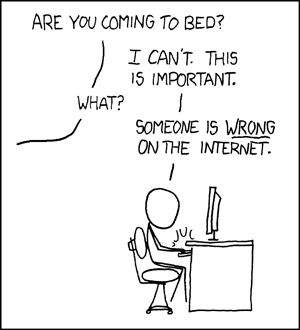
This famous 2008 cartoon from xkcd says it all.


The most important thing to remember when you encounter unpleasantness is: take a breath, verify facts, and don't over-react. As Bob Mayer said on his blog last week: "The internet is a very dangerous place. I’ve seen internet lynch mobs go crazy over the slightest thing (done it myself a time or two) but a day or two of waiting and watching isn’t going to change anything."

When cybermonkeys start tossing verbal feces around a forum or blog, treat it like any other pile of poop.
  • Carefully walk around it.
  • Realize you don't have to tell anybody what it is. Its stink will give it away.
  • Call maintenance.
  • Go someplace cleaner.
You might want to send private messages of support to victims, but don't stand up for victims in cyberpublic no matter how much your inner Atticus Finch is hurting to speak.

I didn’t follow that advice recently and I'm still scraping stuff off my shoe.

Rule #7 Stay Out of Rough Neighborhoods


Absolute Write is no longer recommended. I used to suggest looking there for info on bogus agents and scam publishers. These days, it's so dominated by bitter, bad-tempered snark, you'd probably be safer with the scammers.

Amazon Forums: The Deadwood of the publishing frontier. Brutally anti-author and out of control with vigilantism.

LinkedIn Writers Groups. Some may be safe, but I've unsubscribed from all the ones I belonged to. Way too many rageaholics. LinkedIn is the most invasive of all social media and if you're not on it because of work, I'd recommend you stay away. They'll try to trick you into giving them access to all your email accounts so they can spam every one of your contacts mercilessly in your name, including every agent you've ever queried.

Goodreads: Mean Girls meets Lord of the Flies. This site has been desperately in need of adult supervision for a long time. Recently, they have made big steps in cleaning up the site, but I'd still suggest you stay in safe, author-oriented groups. (I'm fond of my BoomerLit group.) And don't read your reviews!

Or, to be really safe, follow the advice one agent tells her clients: "Go to Goodreads to put up an author profile. Link to your blog. Log out. Never go back."

Rule #8: Change your definition of "review" and don't take online reviews so seriously


1) An online product review is nothing like a traditional book review. When most of us think of a book review, we think of something in the New York Times, or a thoughtful assessment of a work written by a sincere blogger who has read the book and done some careful thinking and writing about it.

But online product reviews—as established in the early days of the Internet—are essentially comments, like the comments you see at the end of online news stories or a You Tube entry.

That means some online "reviewers" bear the same resemblance to traditional book reviewers that homicidal baseball fans do to sports commentators: not much.

2) Cruel, angry reviews say more about the reviewer than they do about your book. And they put you in excellent company.  I know yours hurt like a physical wound, but it helps to read some of the idiotic one-stars of the classics.

3)  It's an urban myth that Amazon requires a certain number of reviews or stars or "likes" on your author page to "move you up the ranks." Only one thing does that: sales.

Some advertising newsletters like Kindle Nation Daily, E-Reader News Today and BookBub do require tons of 5-star reviews, but I think that encourages gaming the system so I use advertisers that don't, like E-Book Bargains UK.

For actual readers, it's much more important to have a few good reviews and some good editorial reviews from well known authors. So don't obsess.

4) A lot of people view retail site reviews as a place for comic relief. Some can be hilarious. Actor George Takei recently made "top reviewer" status on Amazon for his reviews of odd products. I dare you not to laugh.

Others can be morbid and weird, like the Yelp reviews of the hotel where a body was found in the water cistern, or reviews of a wife-killer's "self-help" books.

5) Bad reviews don't always mean bad sales. One young writer engaged in an ill-advised snark battle with an ex that ended up in getting her book over 100 one-star nasty, racist reviews. But her book seems to be selling briskly.

6) Amazon also has an ultra-competitive "top 500/100/50 reviewer" program and you can get caught in their games. According to many reports, Grand Theft Auto mentality is rampant there. Reviewer-on-reviewer bullying and competition can be toxic. I've seen them use review comments and "useful" voting buttons to harass each other. Or they give one-stars to books their rivals love. With the author or vendor getting caught in the middle.

This is obvious breach of Amazon rules, so clicking the "report abuse" button usually solves the problem, but it can be traumatizing for the baffled author.

There is a rigid Amazon review culture and fall afoul of it at your peril. I've just heard of a new book about it called How to Get Good Reviews on Amazon by Theo Rogers, which may explain some more of the arcane rules.

7) Most people who write product reviews and comments are sincere, helpful customers, and some Amazon book reviewers are old school literary experts who could be published in any upscale magazine.

The best way to clean up the review system is add your honest reviews to the mix. Join the ranks of the sincere and helpful! 

I know sometimes it seems as if nastiness on the Interwebz is getting worse, but according to some, it's actually turning around. In the May 2013 issue of Esquire, Stephen Marche said: "The Internet has reached peak hate. It had to. At every other moment in history when there has been an explosion of text — whether through social change, like the birth of a religious movement, or technological change, like the advent of print — a period of nasty struggle ensued before the forces of civility reined it in."

Let's hope for those forces of civility to step in soon.
***

Please don't discuss any specific recent incidents of bullying in the comments, or we'll attract monkey-poo (and if you see it, don't respond. Let it stink for itself.)

But don't keep bullying stories to yourself. Lawyers, law enforcement, and journalists are collecting information and will be grateful for your input. You can leave an incident report for NBC news here. There's more info at the International Bullying Prevention Website.

What about you, scriveners? Do you think Internet can be civilized? What other rules should writers follow to stay safe? Can you recommend other safe places for writers? Know of any other bad neighborhoods we should avoid? Do you think retailers should drop the "star" system on online reviews?


Book Bargain of the Week

Food of Love: a comic thriller about dieting, chocolate, and a small nuclear bomb.

Part thriller and part screwball romantic comedy, Food of Love is a rollercoaster comedy that also addresses complex issues about body image, religion and a woman's right to choose.
Usually $2.99, now only 99c on Amazon , Amazon UK and NOOK


"This hilarious page-turner packs a profound satirical bite. It's a Hollywood romp that provides romance, mystery, and an honest confrontation with the human condition. Food of Love is a funny and powerfully healing book." ...Lucia Capacchione, PhD, bestselling self-help author, Recovery of Your Inner Child

Opportunity Alerts

Looking for an editor? Are you an editor? Sign up for GalleyCat's Freelance Editor Directory. 
As a service to the writers and editors in the GalleyCat audience, they are building a free, automatically updated directory where editors can post their services and writers can seek freelance editors. It's FREE. GalleyCat is one of the top resources in the publishing industry.

Become a Certified Ghostwriter! with the only university level course in ghostwriting. Designed to expand or launch lucrative, professional careers, this course meets online Mondays from 5:30 - 8:30 PM Pacific beginning Oct 14, 2013. Certification at the end of the two semesters is conferred by California State University, Long Beach.

Boomers!! The Huffington Post's Huffpo50 is now publishing short fiction! The rules: You must be 50 or older to enter. Writers can submit only one story per year, and all pieces must be 5,000 words or less. Send your original submissions, as well as your contact details, to 50fiction@huffingtonpost.com.

Get your book international visibility for a reasonable price. EBUK
is now advertising bargain books to a dozen countries, including the US and Canada. You can get more info here. Make sure your book is under $3.99 and provide links to all stores, not not only Amazon (unless you're in Select.) Ads are a little over 10 bucks until the end of August. And you can sign up for the newsletter for your country right here. I've signed up for the new US version. If you like bargain ebooks, this is a great free service.

Military Sci Fi Anthology. VFW: Veterans of Future Wars from Martinus Publishing. Write Military stories? Could one of them be set in the future? This is the anthology for you! 2000-6000 words. Make sure to follow submission guidelines. No docx files. Deadline Dec. 31, 2013.


***

This month Anne has an article about the pressures social media puts on authors at Talking Writing, the magazine for creative writers and readers.
Read More
Posted in Amazon Review Guidelines, Amazon rules, Awesome Screenshot, Bob Mayer, Cyberbullying, Facebook, Goodreads, Google+, How not to spam, How to stay safe online, Kirkus, nasty book reviews, Stephen Marche | No comments

Sunday, 21 July 2013

Social Media Secrets Book Marketers Don't Tell You—Part I: How to Avoid Twitter-Fritter and Facebook-Fail

Posted on 10:15 by Unknown

First: many thanks to Indies Unlimited, which named this blog to its 10 Blogs and Websites Every Indie Should Know. If you're an indie, or thinking of going indie (self-publishing or small-press), do follow them for great tips and news from a very savvy team of writers.

Most writers these days know a good book isn't enough to get you successfully published. Any agent, editor, or book reviewer is going to Google you first—often before they'll even read to the end of your query. Certainly before they request a partial or a book to review.

What comes up on that Google search can make the difference between getting an agent, publisher and reviews—or languishing in obscurity.

Yes, of course it's possible to become a successful author without an online presence, the same way it's possible to get hired for a corporate job if you write your resume on parchment and send it by carrier pigeon.

But your chances are a whole lot better if you conform to established standards.

A couple of months ago, I wrote about how authors spend too much time doing meaningless busy work trying to "build platform." 

But I didn't say authors can ignore social media entirely. Social media is our most important tool for getting our books discovered.

Being on social media takes you out of the confines of your own backyard and puts you into the global marketplace. It makes the difference between hawking your book on a local street corner and getting it in front of millions of readers all over the world.

Thing is: we need to learn to use this tool effectively.

Unfortunately, a lot of marketers don't seem to know how to do that, so they bully authors into wasting a huge amount of time playing meaningless number games.

Understandably, some authors are getting annoyed. Last week, much-lauded literary author Benjamin Anastas quit Twitter and vented in an eloquent blogpost. It got a lot of cyberink and sparked some interesting pieces by Jane Friedman and Porter Anderson.

Mr. Anastas voiced his many quarrels with Twitter, most of which boiled down to: Twitter is no good for selling books, and therefore a waste of time.

Thing is, he's right on the first point, but not on the second.

To me, it sounded like somebody saying he was going to get rid of his phone because it's not good for selling aluminum siding to strangers who are just sitting down to dinner.

Mr. Anastas is a smart man, so I suspect the problem is he was never told what Twitter is really for. (Maybe because his marketing department doesn't know either.)

So...ta-da!

Here is the big secret about Twitter: 

It is not a direct marketing tool. It is a method of communication.

Kinda like a phone. Here's some stuff Twitter IS good for:

1) Quick communications with a large number of people. 

Example: When I was in despair trying to get this blog's Feedburner email program to work last week, I Tweeted asking for help. Within minutes, I had several suggestions, plus a step-by-step guide for converting to a free Mail Chimp email service. (Thanks, Molly Greene!)  I hope I've done it right. Do tell me if you've subscribed and you're still not getting your email notices, or if it's missing from your rss feed.

2) Getting up-to-the minute news from anywhere on the globe.

Example: When there was a tornado in Tuscaloosa, and I wanted to know if my Tuscaloosa friends were OK, I went to #TuscaloosaTornado and found hundreds of real-time Tweets telling what neighborhoods had been hit.

3) Giving your friends a shout-out (and occasionally yourself.)

Example: When I saw that a friend who's a newly minted agent had been mentioned in Publishers Lunch, I Tweeted it, with a @ message to her. It was the first she'd heard of it, so it was a two-bird stone. I informed her of the good news and at the same time let a lot of people know about her new agency.

And yes, you can toot your own horn occasionally. You can certainly Tweet "my book was just nominated for a RITA" or "I got a rave review from Big Al."

But only do this a few times. Imagine you're phoning your friends with the good news, not cold-calling everybody in the phone book.

However, the most important Tweets might be for a friend's triumph. This week, a Tweep posted a link with an @ message congratulating us on our Indies Unlimited kudos. I thought—"what a nice thing for her to add a special Tweet to me. Who is she, again?" I visited her blog, was intrigued, and bought one of her books.

Yeah. That's how it works.

4) Connecting with people. 

Example: Somebody asks a question on this blog. I take some time with the answer and want to let the commenter know there's an answer waiting. If her name leads to a Twitter profile, I tweet her a heads-up. Yes, I could send an email or DM, but a Tweet lets other people who might be interested know the post is there, too. I might add a hashtag like #blogging if that's what it's about.

That way we've made one connection on the blog and another through Twitter. That means we'll take more notice of each other the next time we meet online.

5) Sharing information and talking about it.

This can be anything from Tweeting a tsunami warning for your patch of coastline to links to your own newest blogpost or an article about the new Veronica Mars movie (especially if your tweeps are mystery lovers.)

Example: A few days ago I Tweeted a link to an article about the copy of J.K. Rowling's pseudonymous book that sold for $6000+ and added I thought this thing was getting silly. A few people Tweeted back their responses, including Tweep AJ Sykes who said "Agreed. Or maybe it's ugh-greed."

Clever and funny. And I remember him saying some wise things in a comment on Jane Friedman's blog last week. So now he's on my radar as a clever, funny guy. I see he writes steampunk. Not my genre of choice right now, but I ever make the steampunk plunge I know where to go first.

See how that works?
  • Notice I did not say anything about telling strangers what you had for lunch. 
  • Or hammering them with "buy my book" messages. 
  • Or Tweeting endless snippets of text from your opus. (I know marketers love that, but it's so overdone it's all just noise to most of us.) 
Yes, you can tweet that a great book is free or on sale. And that book can be yours, but don't do it more than three times a day. In between other stuff.

And you can Tweet other people's books, too—but only if you genuinely think your followers will like it. Tweeting books you haven't read may seem to be "friendly" to your fellow authors, but it's not friendly to your Tweeps. And it can backfire if it's not a book you'd recommend to a real life friend. Somebody who writes violent thrillers has no business asking a writer of children's books or cozies for a Tweet. It's OK to say no.

Especially since simply Tweeting book titles at strangers does not sell a lot of books anyway. That's what Benjamin Anastas was right about.

But exchanging information can make connections. It's those connections that will get you known so that somebody might want to buy your books some day.

But you don't have to spend a lot of time on those connections. Mr. Anastas complained of Twitter being a time suck—and it certainly can be. But only if you let it.

And that's another way Twitter is like your phone. A phone can't dominate your life if you don't turn it on. Don't dump the phone, just don't pick up if you don't want to talk.

And those marketers who say you should be adding 20 random Tweeps a day so you can amass half a million followers?

That's like saying you should buy a phone with the numbers of 500,000 strangers programmed into it.

If they don't want to talk to you—what exactly is the point?

For more on Twitter—especially for newbies—see my post on Twitter for Shy Persons.

And for some info on how some clever people are making Twitter more useful for book marketing, check out Julie Valerie's review of BookVibe.  It's a new program that analyzes Twitter streams for book discovery. It sounds as if there still are some bugs in it, but it may mean that Twitter will be a better place for direct marketing in the future than it is now.

Now for some Facebook secrets…

I'm not going to pretend to be an expert on Facebook. I'm kind of a Facebook hater. But that's partly because it's taken me so long to learn to use it. For at least a year I didn't post anything but links to my blog, bits of publishing news, and announcements of my book launches (Yeah, I launched 7 in a year, plus 3 anthologies. I guess I didn't have much else to talk about.)

But this year I started posting literary cartoons, inspirational stuff about books, and a few jokes. All of a sudden, I started having fun conversations on FB.

And this week I saw a great post from Kristen Lamb that gave me an a-ha moment.

It solidified all the stuff I've been learning by trial and error for the past six months. (Lots of error.)

1) Don't just "friend" people.

BE a friend. Connect with people in a non-phony way. NOT writer to fan. Person to person.

2) A personal "friend" page is more valuable than a "like" page.

You can stop humiliating yourself begging for "likes." They mean absolutely nothing if people don't make return visits. And why do you want that Christian picture book writer to like your BDSM erotica page, anyway? It will do nothing for you and will signal Facebook to send some very unwelcome advertising her way.

People would rather be your friend than worship at your feet. Don't expect people to "like" you if you don't do anything likeable.

3) Nonstop bragging isn't especially likeable. 

How weird is it that I have to say that? But I do. That's because marketers tell us to advertise 24/7. When what we should be doing is joking around and getting to know people.

4) LOLCats, Oprah-quotes, and funny stuff from George Takei will sell more books in the long run than all those "book launch party" pages, pleas for tweets, or those links to Publisher's Lunch. (Yes, I'm seriously guilty of that last one.)

As Kristen said in her post: "People can’t connect emotionally to yet another DBW article about how Barnes and Noble’s stock is tanking. They CAN however connect to kittens, Sharknado, tales of missing socks, superheroes, kid stories, pet stories, Mayhem and Grumpy Cat."

5) Facebook author pages don't get much traffic because you can't use them to interact with people. They just sit there saying "worship me." All most of us do is post news about our books. Which snoozifies pretty much everybody if it's non-stop.

Here's Kristen again. "There are writers who seriously believe that Facebook is out to get them because their fan pages are being hidden. NO. It’s just that, in the Digital Age, there is a steep price for being boring."

I wish I'd read Kristen's post three years ago when I started on Facebook. I've wasted a lot of time being boring. Here's another quote:

"Engage us, talk to us, stop selling to us and guess what? We will like coming to your page. And we will have fun and "Like" stuff, comment and SHARE your content." It's worth reading her whole post.

6) The most important Facebook pages aren't your personal pages or your author page. (Or those endless promotional "event" pages.)

They are your friends' pages.

If you visit your friends' pages and make them feel like equals rather than minions, and encourage them through their triumphs and crises, the way you'd like them do do for you, they will reciprocate.

And they might even be interested in reading your next book.

Yeah. That's how social media works. It's, um, social. And as with all social interactions, the best rule is always the Golden one.

In August, I'm going to post Part 2. I'll be talking about how blogging revived my career, and I'll divulge the #1 blogging secret no blogging guru will tell you. 

So what about you, scriveners? Have you been feeling the way Benjamin Anastas does about Twitter? What do you think you could teach marketers about social media? Any tips to add about Twitter and Facebook?

THIS WEEK'S BOOK DEAL 

Sale extended! 99 cents for three hilarious mysteries. Thanks everybody, for keeping it in the top 50 in comic fiction on Amazon for five weeks!

Available on Amazon US, NOOK, and Amazon UK


"The Best Revenge, Ghost Writers in the Sky and Sherwood Limited are hysterical. Anne Allen will keep you laughing throughout, but in the meantime she dabbles her fingers in some topics worth some serious thought: sexism, weightism, lechery, murder, duplicity, homelessness & poverty to name a few. If you love to laugh, you'll like these three books. If you love to think, ponder AND laugh, be ready to fall in love"... C.S. Perryess


OPPORTUNITY ALERTS


1) The Alice Munro Short Fiction Contest. Entry fee $25 adult, $10 Teen. $2000 (Canadian) in prizes. 5000 words or less, unpubished work. More info at Alice Munro Festival Short Story Competition Deadline August 1.

2) Quirk Books "Looking for Love" contest. They offer a $10,000 prize for the best quirky love story of 50,000 words or more. Visit the Quirk Books website to download the entry form or for further information. Quirk Books was founded in 2002 and publishes around 25 books each year. Their bestselling titles include Pride and Prejudice and Zombies and Miss Peregrine’s Home for Peculiar Children. Entries close October 1.

3)  The Huffington Post's Huffpo50 is now publishing short fiction!   The rules: You must be 50 or older to enter. Writers can submit only one story per year, and all pieces must be 5,000 words or less. Send your original submissions, as well as your contact details, to 50fiction@huffingtonpost.com.

4) COMPOSE Literary Journal. Submissions are open for their Fall 2013 issue.  This prestigious journal was founded by Suzannah Windsor, of Write it Sideways, and she's put together an amazing editorial staff. They are looking for art and photography as well as poems, literary short fiction, novel excerpts and essays. Must not be previously published (that includes anything that has appeared on your blog.)

We love your comments! If you can't get through Blogger's hoop-jumping, send me an email at annerallen dot allen at gmail dot com and I'll post it personally.

Read More
Posted in A.J. Sykes, Facebook, How to be Googleable, Indies Unlimited 10 Best Blogs for Indie Authors, Kristen Lamb, Marketing, Porter Anderson, Social Media Marketing, Twitter | No comments

Sunday, 19 May 2013

How NOT to Self-Publish: 12 Things for New Indies to Avoid

Posted on 10:06 by Unknown

Self-publishing has lost its stigma, and it’s the publishing path of choice for a lot of writers these days.

But that doesn’t mean it’s easy.

Or that everybody who self-publishes will succeed.

Unfortunately, I’m seeing a lot of writers dive in head first without having a clue what they’re doing. Even long-time trad-pubbed authors who think they know the ropes can make fatal errors because self-publishing has a different set of rules. One of them lamented his fate in an article in Salon recently.  

But the poor guy had an amateurish cover (not-to-do #3)  and a dismal Amazon buy page (#4). He also tried to market an ebook like a trad-pubbed book (#7). Most of all he seems to think self-publishing means “second-class,” so he presented his book as a second-class product.

Full disclosure here: I'm not self-published. I'm "indie" in the old fashioned sense—I publish with a small, independent press. But I belong to lots of indie groups where the vast majority of authors are self-published. Quite a few are doing very well for themselves—better than the average mid-lister with a big publisher—but many more aren't.

Unlike Tolstoy's happy families, most happy indies are not alike. Successful indies seem to follow quirky, personal paths. But the less successful ones seem to make similar mistakes.

If you want to launch a career as a professional, self-published author, here are some things it's better not to do.

1) Publish your first novel before you’ve written a second. 

The most popular way of marketing a self-published book right now is giving away a lot of free copies. But this only works if you have other books for the customer to actually pay for.

You should write at least two novels before you try to publish—whether you’re hopping on the query-go-round or self-publishing. Marketing takes a whole lot of time, and once you’re doing it, writing novel #2 is going to be really tough. Give yourself at least two novels worth of time before you jump into becoming an author-publisher.

2) Think you don’t have to follow “writing rules” because you’re not dealing with agents and publishers. 

A lot of those "agent rules" are based on stuff that’s hardwired to the human brain. If you’re boring or self-indulgent, you’ll get bad reviews, disgruntled customers and dismal sales.

Some agent rules can be ignored, like "no prologues", "never use the word 'was',"  and “if you’re not writing YA Steampunk Zombiepocalyptic dystopian romance, go die."

But things like, “start with an inciting incident, not 49 pages of musing”…that’s going to be a good rule no matter how you publish.

And yeah, you need a plot. Successful self-publishers are almost all genre writers. Literary musings probably aren't going to sell to an online audience—and successful indies make most of their sales online.

Also, you still have to learn basic spelling and grammar rules. They are the tools of your trade.

3) DYI editing, cover design and formatting 

Some of the early Kindle pioneers got away with amateurish presentation. There weren’t so many ebooks to choose from in 2009 and 2010. Now, there are 1000s of new indie titles coming out every day. You gotta have a professional-looking product or you’re not going to sell.

4) Amateurish buy page 

Lots of indies neglect their buy pages on Amazon, Kobo, Barnes and Noble, etc. Make sure you take advantage of the "editorial reviews" section if it's offered, and include quotes from good blog reviews. Check to see if the “peek inside” feature is working, and write a snappy product description.

Here's some great advice on how to write a compelling product description in a guest blogpost from indie superstar Mark Edwards.

5) Market exclusively to other authors

Unless you have a nonfic book for authors like HOW TO BE A WRITER IN THE E-AGE (had to get a plug in there), other authors aren't your market.

Bloghops are a fun way to get to know other authors, but they don't sell a lot of books

And guilt-tripping and spamming author sites that are meant for mutual support and exchange of information is going to backfire. There are some authors I'm much LESS likely to read because they’ve hijacked author info sites with “tweet and share and make my book the most successful in history and screw you if you have a book to sell too because I’m going to bump my posts up the thread every 15 minutes…it's all about me, me, ME!!”

You want to make FRIENDS with other authors, not get to the top of their list of "A**hats to Avoid."

Successful indie authors know their audience and market to that niche. As indie publishing guru Orna Ross said, "to succeed as an indie you need to go where your readers are, which means understanding your place within the reading ecosystem."

6) Solicit a bunch of phony rave reviews 


Getting Aunt Susie and the gals in her garden club to all write glowing reviews of your opus can backfire, big time. Buying fake reviews is even worse. Ditto manipulating other authors into positive review exchanges. Some writers have even written themselves dozens of  rave reviews under various aliases. All this stuff erupted in a big review scandal last September.

Amazon responded by removing 1000s of reviews and banning some writers from Amazon for life. You may not love the Mighty Zon, but it still sells more ebooks than any other site. You’d miss them.

And don't bully your readers into reviewing. It's fine to ask for reviews from time to time, but readers are starting to get fed up with all the begging, spammy newsletters. An angry reader vented on the subject in the HuffPo recently.

7) Expect a lot of sales right away

Self-publishing works on the principle of slow building. It doesn’t work like traditional publishing with a big splash, push for about a month, then a slow petering of sales, followed by returns, pulping the leftovers and rinse, wash, repeat. Self-publishers sell mostly ebooks, and ebooks are forever.

A title can sell nothing for months—or even years—then suddenly take off once you’ve built an audience with other books.

8) Put on an expensive book launch party 

If you want an excuse for a fun get-together with your friends who haven’t seen you all those years you’ve been in your writing cave—fabulous. You deserve a celebration.

But as a marketing tool, it doesn’t make much sense. A real-world book launch is expensive. Even if you can get it in the local paper, you’re not likely to make enough money back to pay for it unless you have a very large, wealthy, extended family who have all pledged to buy copies in bulk.

9) Treat other authors in your genre as rivals instead of colleagues

It’s not a zero-sum game. The rising tide raises all boats. If your genre is hot, more people will read it.

One of the most disappointing things in the review scandal last fall was discovering that some authors were actually writing fake 1-star reviews for other authors in their genre, in some misguided hope they’d push their “rivals” off the bestseller lists.

That’s not the way it works. If you can get interest in your genre, all the authors in it will sell more. Teaming with more successful authors can do nothing but help your own sales. Patrice Fitzgerald did this with Hugh Howey—getting his permission to write a novella in his Wool series—and her career took off.  So who knows, you might actually be able to collaborate with the star in your genre some day, the way so many authors do with James Patterson.

Appearing in anthologies with big sellers can also really boost your sales. So don’t fight them, join them!

10) Publish through a vanity press 

“Oh, sure. I know that,” sez you. "I’d never get duped by a scammy outfit like PublishAmerica. I’m going with a big name publisher: Simon and Schuster. I'm using their self-publishing wing, Archway."

Sorry. Archway is run by AuthorSolutions, a notorious vanity publisher (even though AS is now owned by Penguin.) A lot of people thought the Penguin buy was a bad move, and the lawsuits suggest that’s the case. Unfortunately a lot of other traditional publishers are teaming up with AuthorSolutions too, like Hay House's Balboa Press, Thomas Nelson's West Bow Press, and Harlequin's Horizons. Don't go there.

For more on vanity presses and how to avoid them, see David Gaughran's Blog or  Writer Beware.

You don’t want to publish with a vanity press because they make money off the author, not book sales. They often charge 10 times what the normal self- publishing route would cost and the books are so overpriced you can’t make a profit selling them.

There is a tried and true method of self publishing that almost all self publishers use. Don’t self-publish without reading this from Sarah Woodbury. There are a whole lot of books out there on self-publishing. Probably too many, as Porter Anderson lamented in Writing on the Ether this week. The one I see most highly recommended by successful indies is David Gaughran's, Let's Get Digital. (on sale for 99c this week. No. Mr. Gaughran doesn't give me kickbacks, alas.)

The indie’s best friend, Mark Coker of Smashwords, has lots of great information on his site for free. Or  if you need affordable help with the tech side of self-publishing, try BookBaby or Draft2Digital. Smashwords, BookBaby and Draft2Digital help you with formatting and post to retail sites for you, but they are not publishers or vanity presses. BookBaby provides ebooks and pbooks (paper).

The two biggest pbook printing companies are CreateSpace (owned by Amazon) and LightingSource (owned by Ingram, the biggest distributor to bookstores in the US) Lulu is good too, but beware their more expensive packages—those have gone over to the Author Solutions dark side, too

11) Believe there is one formula for publishing success 

What worked in the past may have been overworked since then. And what sells books in one genre may not work in another. Every book and every marketing plan has to be different.
  • Prolific chick lit author D.D. Scott keeps on the bestseller lists with her “Snickers bar” pricing, but her method may not work for every genre. 
  • Some authors find professional blog tours are a great way to launch a title. Others say they’re an exhausting waste of money.
  • Sci-Fi superstar Hugh Howey used the cliff-hanger serial format to build his audience. But a whole lot of authors have tried the serial thing since then and only managed to infuriate readers who expected a whole story.
  • Giving away free books has been the big thing recently. But everybody’s Kindle is full of freebies now, so this may not work for long.
  • At the moment, everybody’s having pretty good luck with those expensive ads on places like BookBub and Kindle Nation Daily, but Amazon no longer allows “affiliates” to advertise unlimited free books, so we’re not sure if they’ll have the same cachet a few months from now. (Some cheap ebook newsletters are not affiliates, like the UK bargain book site below.) 
Pay attention to your own sales and what seems to boost them. Do more of that. And be patient. Very patient. And go write another book. That’s the only proven way to increase sales.

12) And the biggest no-no of all? Dissing a reviewer who doesn’t like your book

Somebody is going to hate your book. I guarantee it. And they may be snarky about it. Especially if the book is self-published. But trad-pubbed books get nasty reviews, too. Look at the nearly 150 one star reviews of The Great Gatsby. Or some of the bad reviews J.K Rowling got for the Casual Vacancy. Every reviewer dislikes some books, and some reviewers revel in their dislikes. Put-downs can be fun, unfortunately.

Accepting the snark with grace is part of being a professional. You will feel the sting, of course, but deal with your anguish offline. Anything you do in response to a negative review is likely to backfire in a major way.

Note: this does not extend to bullying. Most bad reviews are not “bullying,” but some misguided morons do abuse the review system in order to attack or "punish" authors for imagined transgressions or out of sheer malevolence. People who use reviews for bullying generally follow a certain pattern.

1) They make it pretty clear they haven't read the book
2) They attack an author personally
3) They often attack in packs, using identical talking points
4) They may be organized by a "rival" author (yeah, mean people are usually kinda stupid, too.)

If you are being bullied, do NOT respond to the bullies in the comments or engage with them in any way. But DO report them for abusing the review system. I'm glad to hear that Amazon is rolling out a new program for reporting abuse. If you see this kind of bullying happening on any author's buy page, report it.

All writers benefit from fighting this kind of abuse, because it renders the whole review system useless.

If you're a victim, stay away from groups where bullies hang out and try to get some good professional reviews to quote in your product description to counteract the lies.

And trust that your readers can tell the difference.

If you want to read more about online bullying, I wrote a post a couple of weeks ago on Gangs of New Media.

If you're still sitting on the fence about self-publishing, Orna Ross has a great post this week at Jane Friedman's blog with 15 questions to ask before you self publish.

If you'd rather go the traditional route, but don't write in a genre on the agent hot list right now, take a look at indie presses. Escargot Books, listed below, has just opened to submissions in most fiction genres and accepts both agented and non-agented work. And there's a list of small digital presses with ratings at ePublishaBook.com.

What about you, scriveners? Have you made any of these mistakes? Have they turned out not to be mistakes at all? And what’s up with that steampunk stuff? If agents love it so much, why isn’t it all over the bestseller list? Have I missed something? What other advice would you give a new indie author? Have you ever been bullied by a review bully? 


BOOK DEALS THIS WEEK


Roxanna Britton, a biographical novel by Shirley S. Allen will be FREE on Amazon from May 22-25. It's Little House on the Prairie meets Jane Austen. In this wonderful novel, my mom tells the story of her own great-grandmother, an amazing pioneer of the Old West.

 "This true biographical novel of an American pioneer is gripping and exciting in every sense. From Ohio to California one cannot help but admire the courage of the Britton women... If true history is your cup of tea, I strongly advise you to buy this book."--Karen Mabry Rice

"A family saga I could not put down. Ms. Allen has written a fascinating tale of real people, full of danger and tension, in prose that flows easily and pulls the reader along."--Susan Tuttle

The Gatsby Game, based on a real unsolved Hollywood mystery, is only 99c at Amazon and Barnes and Noble. through May 31st, in honor of the debut of the Baz Luhrmann film. It's based on the mysterious death of David Whiting, a man I knew in college. Nobody knows what happened the night he died in Sarah Miles' motel room during the filming of a Burt Reynolds movie, but I have a theory, and this is a fictionalized account of it. Like David, my anti-hero Alistair Milbourne is obsessed with F. Scott Fitzgerald, and imagines himself to be "the ghost of Jay Gatsby, in a straw boater and spats, whistling a tune by Cole Porter." 

"I was thoroughly entertained by The Gatsby Game. It has all the elements for a good mystery, and would also appeal to readers who enjoy romance in a women’s fiction style. I give the characters, cultural references, story building, and especially the slightly sarcastic narrator voice a 5 star rating" --Donna Hole

OPPORTUNITY ALERTS 


1) Iron Writer Insane-a-Thon!

The Dreadful Cafe will hold their annual writing marathon on July 13, 2013. There are prizes for the most words written in a 24 hour period and for raising the most money for their charity, St. Jude's Hospital. It's a wild and crazy insane-a-thon for a great cause. More at The Dreadful Cafe. Send in your entry to submissions@dreadfulcafe.com before July 14th.

2) Spoonfuls of Stories Contest 

For new, unpublished writers of children's fiction. HUGE prizes for the winning stories for children age 2-6. This contest, sponsored by Cheerios, offers a $5000 grand prize and some hefty runners-up prizes too. More info at spoonfulsofstories.com  Deadline is July 31. 

3) FREE book advertising to British readers from EbookBargainsUK 

DEADLINE EXTENDED! Lots of authors and publishers have had huge successes with their free or sale books by advertising on BookBub, ENT, KND, POI, etc. But none of those target the UK, and their links go to US sites Brits can't use. But now there’s a newsletter for UK readers only. It links to all the big UK retailers like Apple UK, Waterstones and Foyles as well as Amazon UK. They don’t sell books direct or get paid for clickthroughs, so they don't have any restrictions on how many free books they can spotlight like BookBub and the others. So it's THE place to tell Brits about your book when it goes free or on sale in the UK. Since Brits have the highest number of readers per capita of any country in the world, this looks like a great idea to me: Plus: the site will be offering FREE book ads until June 30th, on a first come, first served basis.

And if you're in the UK, do sign up for their newsletter. It brings links to free and bargain ebooks—at the UK bookstore of your choice—in your inbox every morning. You can subscribe here.

4) Orion Magazine


Submission Window Opens June 1  “America's finest Environmental Magazine" is open to submissions only three times a year. Orionaccepts essays, narrative nonfiction, interviews, and short fiction that focus on nature, culture, and place. 1,200 to 5000 words.

5) Escargot Books is expanding its catalogue and are now accepting submissions.

Crime fiction (dark thrillers to cozies), women’s fiction, health and fitness, children’s, sci-fi and dystopian. All books will be published in digital format. Some books will be chosen for print and/or audio as well. Escargot Books does not offer an advance, but they offer higher royalties than traditional publishers, especially for direct sales from our website, as well as editing, formatting, promotion, and the company of bestselling authors. This is an indie press with some big name authors and a good track record. Here’s their online submission form.
Read More
Posted in Amazon buy page, Blog tour, book launch party, Book Reviews, Facebook, how not to publish, indie authors, Kindle, Orna Ross, rejection, self-publishing, Social Media, vanity press, writing rules | No comments
Older Posts Home
Subscribe to: Posts (Atom)

Popular Posts

  • The Rules of Writing...and Why Not To Follow Them
    Somerset Maugham famously said, "There are three rules for writing. Unfortunately, nobody knows what they are." But pretty much ev...
  • The Secret Writing Rule Book…and Why to Ignore It
    Somerset Maugham famously said, "There are three rules for writing. Unfortunately, nobody knows what they are." But pretty much ev...
  • Wimpy Kid Eats George Bush’s Lunch
      Last week George W. Bush’s memoir gave Random House their best opening day sales in seven years—170,000 print copies. BUT—on the same day,...
  • Why You Should be Writing Short Fiction
    Update: I'm so pleased this post has had thousands of hits over the last year and is energizing so many writers to take up short fiction...
  • Friday the 13th
    I'm starting a blog on Friday the 13th. What does that say about me? Am I thumbing my nose at superstition, or commencing an exercise in...
  • 12 Dos and Don'ts for Introducing your Protagonist
    Welcome all my new followers. And thanks for all the comments! This weekend I spoke at a local workshop for the mystery writers group, Siste...
  • Rejection, Rotten Reviews, and Social Media: 7 Ways Writers Need to be Like Rhinos
    by Ruth Harris Writers are always urged to have or develop  “rhino skin.” But let me add a few words about rhino skin. When I wrote ZURI , I...
  • How to Blog VI: 15 Tips for Guest Bloggers
    Guest posting on blogs is a great marketing tool. The frenzy for blog tours seems to have quieted down a bit  recently, but whether you’re l...
  • HOW DO YOU KNOW YOU’RE REALLY A WRITER?
    Ever get the “OMG I’m-not-really-a-writer, why-am-I-kidding-myself” blues? Agent Nathan Bransford calls them the “Am-I-Crazies.” Most of us ...
  • 12 MYTHS ABOUT GETTING PUBLISHED
    When you’re a beginning writer, you’re likely to get bombarded with advice from all quarters—your family, your friends, your hairdresser, an...

Categories

  • 'textr
  • #QueryFail
  • #zombiefail
  • $13 e-reader
  • 10 thousand-hour rule
  • 20 Master Plots
  • 20th Century Woman
  • 21st Century prose
  • 21st Century writing
  • 3:17 AM
  • 7 Basic Plots.
  • 99 cent book bubble
  • 99-cent e-books
  • A Christmas Carol
  • A Midsummer Night's Dream
  • A.J. Sykes
  • AbFab
  • Absolute Write
  • Academic Body
  • Achieving your writing goals
  • Adele McAlear
  • Adventures in Children's Publishing
  • advice for nonfiction writers
  • advice for writers
  • advice on craft
  • Advice to writers
  • agent
  • agent blogs
  • Agent Jenny Bent
  • Agent Laurie McLean
  • agent Meredith Barnes
  • Agent rejection
  • Agent Sara Megibow
  • Agent Savant
  • agent scam
  • AgentQuery
  • AgentQuery Connect
  • AgentQueryConnect
  • Aisha Iqbal
  • Alan Rinzler
  • Alex J. Cavanaugh
  • Alexa Ratings
  • algorithms
  • Alice Walker
  • Alicia Street
  • Alison Tait
  • All Fall Down
  • Amanda Hocking
  • Amanda Katz
  • Amanda McKittrick Ros
  • Amazon
  • Amazon Book of the Month
  • Amazon buy page
  • Amazon categories
  • Amazon monopoly
  • Amazon publishing imprints
  • Amazon Review Guidelines
  • Amazon review removal
  • Amazon reviews
  • Amazon rules
  • Amazon Singles
  • Amy Riley
  • Andrea Brown
  • Andrew Loog Oldham
  • AndWeWereHungry
  • Ann Best
  • Ann Carbine Best
  • Ann Lamott
  • Ann Patchett
  • Anne Gallagher
  • Anne R. Allen
  • Anne R. Allen. SLO Nightwriters
  • Anne Rice review
  • Anne Schroeder
  • Anonymice
  • Antagonist
  • Anthologies
  • Apple Store
  • Author abuse
  • Author bio
  • author branding
  • Author Collectives
  • Author Platform
  • Author power
  • Author scams
  • author websites
  • Author's Guild
  • Awesome Screenshot
  • Back Matter
  • bad reviews
  • Bantam
  • Barbara Rogan
  • Bargain Ebook Newsletters
  • Barnes and Noble
  • Barry Eisler
  • Bear State Books
  • Beating the Breakdown
  • Beginning Novelist
  • being yourself on purpose
  • Beniot Lelievre
  • Benoit LeLievere
  • Benoit Lelievre
  • Berkley Heat
  • Best Damn Creative Blog
  • Best Damn Creative Writing Blog
  • Best links for writers
  • bestseller lists
  • beta readers
  • Betty Jo Stevenson Rides Again
  • Big 6 editor
  • Big 6 publishers
  • Big 6-5-4
  • Big Boss Troublemaker
  • Big Publishing
  • Big Six
  • Big Six editors
  • Big Six publishers
  • Big Six publishing
  • Big Six rules
  • Bing
  • Bit.ly
  • Black Balloon Publishing
  • Blake Morrison
  • Blame the Writer
  • Blog a book
  • Blog community.
  • blog followers
  • Blog hop
  • blog kudos Kittie Howard
  • blog of the week
  • Blog tour
  • Blogfests
  • Blogger having technical problems
  • Blogger sux
  • Blogging
  • blogging awards
  • blogging for authors
  • blogging pitfalls
  • blogging rules
  • blogging tips
  • Blogging tips for writers
  • Bloghops
  • blogs
  • Blurbs
  • Bob Mayer
  • bogus agents
  • bogus writing contests
  • Book Blogger
  • book bloggers
  • book doctors
  • book editing
  • book launch party
  • Book Luvin’ Babes
  • Book Marketing
  • Book review blogs
  • book reviewers
  • Book Reviews
  • Bookalicious Pam
  • BookBaby
  • BookBub
  • BookCountry.com
  • Bookends LLC
  • BookTour.com
  • Boomer Lit
  • BoomerLit
  • Boomers
  • Borders
  • Brainwashed
  • Brave New Trail Conference
  • building platform
  • Bullying
  • Burnout
  • Burt Reynolds
  • Butterfly Syndrome
  • C. Hope Clark
  • C. S. Perryess
  • Calibre
  • Camilla Randall mysteries
  • Camille LeGuire
  • Can You Use Song Lyrics in Novels
  • Canadian comedians
  • CAPTCHA
  • Careful or You'll End Up in My Novel T-shirts
  • Casey McCormack
  • Casey McCormick
  • Castle
  • Cathe Olson
  • Catherine Ryan Hyde
  • CC Coast Writers Conference
  • Censorship
  • Central Coast Sisters in Crime
  • Central Coast Writer’s Conference
  • Central Coast Writers Conference
  • Chanel and Gatsby
  • Charity Anthologies
  • cheap ebooks
  • Cheryl Shireman
  • Chick Lit is Not Dead
  • Chick Lit News and Reviews
  • Chocolate
  • Chris Baty
  • Christine Ahern
  • Christmas books
  • Christopher Moore
  • Chuck Wendig
  • Church of the Flying Spaghetti Monster
  • Clarissa Draper
  • Claude Nougat
  • Colleen Lindsay
  • Colonel Baker's Field
  • Colorado Tragedy
  • Columbia College Chicago
  • comedy-mystery
  • comic thriller
  • Compose magazine
  • Connie Brockway
  • Consuelo Saah Baehr
  • Consuelo Saah Baer
  • coping with rejection
  • Copyright
  • Copyright laws
  • copyright your plot
  • Courtnee Howard
  • cozy mysteries
  • Crash into You
  • Crazy-Makers
  • Creating memorable characters
  • creative writing courses
  • creativity
  • Crime Writers of Canada
  • critique groups
  • critique groups and criticism
  • critiquecircle.com
  • Cyber-bullying
  • cyberbullies
  • Cyberbullying
  • Cybermen
  • D. G. Sandru
  • D.D. Scott
  • Dallas Morning News
  • Dani Amore
  • Danielle Smith
  • Dave Congalton
  • David Fagin
  • David Gaughran
  • David Streitfeld
  • David Whiting
  • DC Stanfa
  • DD Scott
  • Dean Wesley Smith
  • Death and Digital Legacy
  • Death of the American Author
  • Death of the Big 6
  • Decades
  • Delilah S. Dawson
  • Depression and Writers
  • Derek Haines
  • Derico Photography
  • developing your writing style
  • DGLM
  • Digital Age Authors
  • Digital Age E-Authors
  • digital paper
  • Do authors need to blog
  • Do I need an agent? platform
  • do’s and don’ts for writing a memoir
  • Does my writing suck? Anne R. Allen
  • DoJ lawsuit
  • Don't Let Me Go
  • Donelle Lacy
  • Donna Fasano
  • Donna Hole
  • Dorothy Parker
  • Double Feature
  • Douglas Rushkoff
  • Dr. Martha Stout
  • Dr. Who
  • Dream-smashers
  • Dreams do Come True
  • Dreams vs. goals
  • Duolit
  • E-Book Revolution
  • e-readers
  • E. M. Forster
  • Ebook Marketing
  • eBook pricing
  • Ebook revolution
  • ebookbargainsuk
  • EBUK
  • ECollegeFinder Top Writing Blog
  • Edit Ink scam
  • Editing
  • Editor David Blum
  • editor Jamie Chavez
  • Elaine Raco Chase
  • Elisa Lorello
  • Elizabeth Ann West
  • Elizabeth Joss
  • Elizabeth S. Craig
  • Elizabeth Spann Craig
  • Emily Cross
  • English major
  • English speakers in India
  • episodic storytelling
  • Eric Feldon
  • Erica Jong
  • Erotica
  • Escargot Books
  • Evernote
  • Facebook
  • Facebook Other Folder
  • Fair Use
  • Fall into You
  • Feedburner
  • Fiction Groupie
  • Fiction writers
  • Fight Depression
  • Finger Lickin’ Dead
  • firing an agent
  • first chapters
  • First Rights
  • fixes for a stalled novel
  • Flipboard
  • Food of Love
  • Foreword Literary
  • Frazzled
  • free books
  • free ebook give-away
  • Free Elements of Style
  • free online resources for writers
  • Freelance book editors
  • Front Matter
  • Funds for Writers
  • Fussy Librarian
  • Future of bookstores
  • Future of publishing
  • Gabriele Lessa
  • GalleyCat
  • Gary Canie
  • Gary Trudeau
  • Gatekeepers
  • Geek-chic
  • Gerry McCullough
  • getting out of your own way
  • Ghostwriters in the Sky
  • GIFs
  • Ginger Clark
  • Glimmer Train
  • Golden Age of Publishing
  • Goodbye Emily
  • Goodreads
  • Google Authorship
  • Google+
  • GooglePlay
  • Gordon Wornock
  • grammar lessons
  • Grammar nerds
  • Gravatar.com
  • Groupthink
  • Guest blogging
  • Hate Facebook
  • Hire an Editor
  • history of the novel
  • Hive Mind
  • holiday gifts for Grandma
  • Holli Moncrieff
  • Hollywood scandal
  • Homer
  • Hooked
  • Hope Clark
  • How to be a Writer in the E-Age
  • How Do I Know I'm a Writer?
  • how much should you pay a book editor
  • how not to blog
  • how not to pitch to agents video
  • how not to publish
  • How not to spam
  • How Not to Start a Novel
  • How to barf a book
  • How to be a good blog guest
  • how to be a successful author
  • How to be a Writer
  • How to Be a Writer in the E-Age
  • How to be Googleable
  • how to blog
  • how to deal with negative reviews
  • How to deal with rejection
  • How to edit your own work
  • How to find a publisher
  • How to find plot ideas
  • How to get a book published
  • How to get an agent
  • How to get your book rejected
  • how to get your book reviewed
  • how to pitch a book
  • How to prepare a manuscript
  • how to publish a memoir
  • How to publish a novel
  • How to Query
  • How to Query a Blogger
  • How to query a book blogger
  • how to query a book reviewer
  • how to sell on Amazon
  • How to sign up for Google+
  • how to start a blog
  • how to start a novel
  • How to stay safe online
  • How to Tweet
  • how to write
  • How to write a bestselling novel
  • how to write a blurb
  • how to write a book product description
  • How to Write a Damn Good Novel
  • how to write a memoir
  • how to write a novel
  • how to write a novel based on real life
  • how to write a synopsis
  • How to write an Amazon review. Amazon star ratings. Jeff Bezos
  • How to Write Better
  • how to write blog headers
  • how to write funny
  • how to write memoir
  • How to write memorable fiction
  • Hugh Howey
  • humor
  • humor writing
  • humorous mystery
  • Husbands and Lovers
  • I Hate Trends
  • IBBA Awards Finalist
  • Imagine: How Creativity Works
  • inciting incident
  • independent bookstores
  • India Drummond
  • indie authors
  • Indie bookstores
  • Indie Chicks Anthology
  • Indie or Traditional Publishing?
  • indie publishing
  • Indies Unlimited 10 Best Blogs for Indie Authors
  • Indiestructible
  • Insecure Writers Support Group
  • Insult Ferrets
  • International Ebook Markets
  • Internet bullying
  • Internet trolls
  • iPad
  • ISBN
  • J. A. Konrath
  • J. K. Rowling
  • J.K. Rowling
  • Jack King
  • Jacqueline Susann
  • James Frey
  • James N. Frey
  • James Patterson
  • Jami Gold
  • Jane Friedman
  • Janet Reid
  • Janice Hardy
  • Jaron Lanier
  • Jason Kong
  • Jeff Carlson
  • Jenna Glatzer
  • Jennifer Weiner
  • Jenny Bent
  • Jeremy Duns
  • Jess Walter
  • Jesse Stone
  • Jessica Bell
  • Jill Corcoran.
  • Jill Metcalf
  • Jim McCarthy
  • Joanna Harris
  • Joanna Penn
  • Joanne Tombrakos
  • Joe Konrath
  • Joel Friedlander
  • John Allen
  • John Green
  • John Locke
  • John Updike
  • Johnny Base
  • Jon Morrow
  • Jonah Lehrer
  • Josh Swiller
  • Judy Salamacha
  • Julia Cameron
  • Julie Luek
  • Jumpstart the World
  • Justin Cronin
  • Jutoh
  • Karen McQuestion
  • Karin Cox
  • Katheryn Smith
  • Kathleen Duey
  • Kathleen Valentine
  • Kathryn Rusch
  • Kathy Carmichael's pitch generator
  • Katie the book-eating dog
  • KDP Select
  • Keeping your sanity
  • Keith Blount
  • Kevin Spacey
  • Kiana Davenport
  • Kick-ass heroines
  • Kill Your Darlings
  • Kill your television
  • Killing Cupid
  • Killing the Blues
  • Kim Wright
  • Kindle
  • Kindle authors
  • Kindle bestseller
  • Kindle books
  • Kindle ebooks
  • Kindle Millionaires
  • Kindle Nation
  • Kindle publishing
  • Kindle Serials
  • Kindle Singles
  • Kindlegen
  • Kindlegraph
  • Kirkus
  • Klout
  • know your genre
  • Kobo
  • Konrath
  • Kris Rusch
  • Kristen Lamb
  • Kristen McLean
  • Kristin Lamb
  • Kristin Nelson
  • kudos
  • L.B. Gschwandtner
  • L.L Barkat
  • Landing a Book Contract
  • landing an agent
  • Larsen-Pomada Agency
  • Laura Morrigan
  • Laurie McLean
  • Lawrence Block
  • Learn to be a ghostwriter
  • learning to fail
  • Lee Goldberg
  • Leslie Kaufman
  • Lexi Revellian
  • Lila Moore
  • Liliana Hart
  • Lindsay Lohan
  • Lisa Perrat
  • Lisbeth Salander
  • Listening to your heart
  • Literary agents
  • Literary genres
  • literary journals
  • Literary Lab
  • Literary Rambles
  • logline
  • loglines
  • long tail marketing
  • Louise Voss
  • Love and Money
  • Love in Mid Air
  • LR Richardson
  • Luddite
  • Lydia Sharp
  • Mac Tonnies
  • Mad Men
  • Mainak Dhar
  • Malcolm Gladwell
  • Man in the Cinder Clouds
  • Marcia Richards
  • Mariano Rivera
  • Marissa Meyer
  • Mark Billingham
  • Mark Chisnell
  • Mark Coker
  • Mark Edwards
  • Mark Williams
  • Mark Williams International
  • Mark Williams international Digital Publishing
  • Mark Zuckerberg
  • Marketing
  • Martini Madness
  • Mary Sisson
  • Mary Sues
  • Mary W. Walters
  • Matthew Scudder mysteries
  • Mean Girls
  • Meghan Derico
  • Meghan Ward
  • Melodie Campbell
  • Meme
  • memes
  • memoir or fiction
  • memoir writing
  • Mental toughness
  • Meredith Barnes
  • Metadata
  • Michael Brandman
  • Michael Chabon
  • Michael Harris
  • Michael Murphy
  • Michael Ventura
  • Michelle Davidson Argyle
  • Micropresses
  • Mid-Sized Publishers
  • Miss Snark
  • missing Amazon reviews
  • Modern Women
  • Monarch
  • Monetize your blog
  • Montlake Romance
  • Morgen Bailey
  • mss.
  • MWiDP
  • My WANA
  • mystery meat navigation
  • Mystery Writing is Murder
  • Nancy Andreasen
  • NaNoWriMo
  • nasty book reviews
  • Natalie Whipple
  • Nathan Bransford
  • Nathan Fillion
  • National Novel Writing Month
  • Neil Vogler
  • New York Review of Books
  • New York Times bestseller
  • New York Times Book Review
  • newbie advice
  • news
  • Newsetters
  • Nick Hornby
  • Night of the Living Dead
  • Nina Amir
  • Nina Badzin
  • Nisus
  • no new stories
  • No Place Like Home
  • Nook
  • Nora Roberts
  • Notes from Underground
  • Novel structure
  • Nuclear testing
  • NYT Book Reviews
  • Office of Letters and Light
  • Olivia Lewis
  • On the Island
  • Open Education Database
  • opportunities for writers
  • Oprah's Happiest Town
  • Orna Ross
  • overdone plots
  • Overrride: a Thriller
  • paid reviews
  • Pam Van Hylckama Vleig
  • Pam van Hylckama Vlieg
  • pantser vs. planner
  • Park Avenue Series
  • Passive Guy
  • Passive voice
  • Passive writing
  • Past perfect tense
  • Path to Publication
  • Paul Fahey
  • Paul Laity
  • Pay it Forward
  • Paying it Forward
  • PeerIndex
  • Penguin House
  • Peter Ginna
  • Pippa Middleton’s Pilates Coach
  • Plantagenet Smith
  • Plato
  • plot boards
  • Poets and Writers
  • Popcorn Press
  • PopularSoda.com
  • Porter Anderson
  • Posthuman Blues
  • Pottermore
  • Preditors and Editors
  • Prentiss Ingraham
  • Press 53
  • procrastination
  • Product Description
  • professional writers
  • prologues
  • proofreading
  • Protagonist
  • Prue Batten
  • pseudonym
  • pseudonyms
  • psychology for writers
  • Public Domain
  • Public Query Slushpile
  • PublishAmerica
  • Publisher rejections
  • Publisher's Lunch
  • Publisher's Weekly
  • publishing
  • Publishing alternatives
  • publishing business
  • publishing in 2013
  • Publishing Industry
  • publishing news
  • publishing rules
  • Publishing scams
  • publishing trends
  • query
  • query hell
  • query letter
  • Query Shark
  • Query Tracker
  • QueryTracker
  • Quotes4Writers
  • Rachel Thompson
  • Rachelle Gardener
  • Rachelle Gardner
  • Rare Stamps
  • Readwave
  • Reddit
  • RedRoom
  • rejection
  • Reviews
  • Rex Pickett
  • RG2E
  • Rhemalda
  • rhinos
  • Richard Castle
  • Richard Dawkins
  • Richard LaPlante
  • Richard North Patterson
  • Rick Daley
  • Riley Adams
  • Robert B. Parker
  • Robert Lee Brewer
  • Robert M. Caruso
  • Roberta Trahan
  • Robin LaFevers
  • Robin Sullivan
  • Robinson Crusoe openings
  • Robynne Rand
  • Roland Yeomans
  • romantic comedy
  • Roni Loren
  • Rotten Tomatoes Reviews
  • Roxanna Britton
  • Roy and Alicia Street
  • Roz Morris
  • Ruth Ann Nordin
  • Ruth Harris
  • Ruth Harris’s Blog
  • Saffi Desforges
  • Saffina Desforges
  • Saffinia Desforges
  • Samuel Park
  • San Francisco Writers Conference
  • San Luis Obispo
  • Santa Claus stories
  • Santa Ynez CA
  • Sara LaPolla
  • Sarah Miles
  • Sarah Weinman
  • Sarah Woodbury
  • Say Yes to Gay YA
  • scams
  • Schmoozing on Twitter
  • Scholastic's trend report
  • Scott Nicholson
  • Scott Turow
  • Scrivener
  • Secret writing rule book
  • Self e-publishing
  • Self-Editing
  • self-published e-book
  • Self-published ebooks
  • self-publishing
  • self-publishing expenses
  • Self-publishing on Kindle
  • Selling Short Stories on Amazon
  • Semantic Search
  • SEO
  • Seth Grahame-Smith
  • Sex scenes
  • Shaun of the Dead
  • Shaw Guides
  • She Writes
  • Shelly Jump
  • Shelly Thacker
  • Sherrie Petersen
  • Sherwood Ltd.
  • SheWrites
  • Shindig
  • Shirley S. Allen
  • short stories
  • Short stories made into films
  • show don't tell
  • Sibel Hodge
  • Sierra Godfrey
  • Sigil
  • Simon and Schuster
  • Sisters in Crime
  • SLO Nightwriters
  • Slow Blog Manifesto
  • slow blogging
  • Slush pile
  • Small Presses
  • Small Publishers
  • Smashwords
  • Smashwords Mark Coker
  • Snooki
  • Snookibooks
  • Social Lasers of Cruelty
  • Social Media
  • social media etiquette
  • social media for authors
  • Social Media Marketing
  • Social Networking
  • Sociopath
  • sock puppet reviews. Elisa Lorello
  • Sock Puppets
  • software for self-publishers
  • Solstice Celebrations
  • Somerset Maugham's rules of writing
  • Sony
  • Spirit of Lost Angels
  • Spywriter
  • squirrels
  • Stamp Album
  • Stand up to bullies
  • Star Trek IV
  • steal your plot
  • Stephen Leather
  • Stephen Marche
  • stepping in dogma
  • Steve Martin
  • Steve Wilhite
  • Story arc
  • Style Guide
  • Style Sheet
  • Stylish blogger award
  • sucky first drafts
  • Sugar and Spice
  • Sunny Frazier
  • Susan G. Komen Foundation
  • Susan Kaye Quinn
  • Suzanne Collins
  • Sylvia Plath
  • Talli Roland
  • Tawna Fenske
  • Tech woes
  • Tech-Savvy Author winners
  • Tech-Savvy authors
  • Temple Grandin
  • ten most notorious hollywood sex scandals of all time
  • Terence Stamp
  • Terry Pratchett
  • The Atomic Times
  • The Beginning Writers Rule Book
  • The Best Revenge
  • The Chanel Caper
  • The Colbert Book Club
  • The Daily Show
  • The Dark Knight Rises
  • the Digital Beyond
  • The Ebook is the new Query
  • The Fault in Our Stars
  • the fearless writer
  • The Frozen Sky
  • The Gatsby Game
  • The Goddaughter's Revenge
  • the Hays Code
  • The importance of detail in fiction
  • The Lady of the Lakewood Diner
  • The Liar's Bible
  • The Literary Lab
  • the most interesting man in the world.
  • The New Yorker
  • The Night and the Music
  • The Organized Writer
  • The Passive Voice
  • The Plague Year
  • the publishing biz
  • The secret rule book
  • the secret to becoming a successful writer
  • the skinny on agents
  • The Slow Blog Manifesto
  • The Sociopath Next Door
  • The Street-Smart Writer
  • The Tech-Savvy Author
  • The Triskele Trail
  • The Virus that Will Not Die
  • The Wizard of Oz
  • the writing life
  • There's a Book
  • There’s a Book
  • This Burns My Heart
  • Thomas and Mercer
  • Thrillerfest
  • Todd Sieling
  • Tom Johnson
  • Tom Selleck
  • Tom Simon
  • Tony Piazza
  • Top 50 Blogs for Authors
  • Topsy.com
  • Tracy Garvis Graves
  • Trafalmadore
  • TribalMessengerDaily
  • Triskele Books
  • trollosphere
  • Trolls
  • Tsunami of Crap
  • Tweepi
  • Twitchforks
  • Twitter
  • Twitter for Shy Persons
  • twitter handles
  • uses for dryer lint
  • using a pen name
  • V.K. Sykes
  • vanity press
  • Vanity Publishing
  • Victoria Mixon
  • Victoria Strauss
  • VidCon
  • Virgil
  • Walk Me Home
  • Wall Street Journal
  • Walter's Purple Heart
  • web design
  • websites that suck
  • Weebly
  • Wendy Lawton
  • Wendy Sparrow
  • WG2E
  • What rejection means
  • What to blog about
  • When I Found You
  • Where We Belong
  • White Queen
  • Why choose traditional publishing
  • Why You Get Rejected
  • Why You Should Write Short Fiction
  • why your manuscript got rejected
  • William Faulkner
  • WIX
  • Woodstock
  • Wool
  • Wordmonger
  • words to eliminate from your writing
  • Write every day
  • Write for your Life
  • Write it Sideways
  • Write it Sideways 101 best tips for writers
  • Writer Beware
  • Writer burnout
  • Writer Masochism
  • Writer Unboxed
  • Writer's block
  • Writer’s Block
  • Writer’s Emotional Health
  • Writer's Toolkit
  • Writers Cafe
  • writers conferences
  • Writers Digest Best 101 Sites for Writers
  • Writers Toolbox
  • writers’ conference
  • Writers' Conferences
  • Writers’ Conferences
  • writing
  • Writing and Depression
  • writing dos and don'ts
  • writing habits
  • writing humor
  • Writing ideas
  • Writing myths
  • Writing prompts
  • writing rules
  • Writing scams
  • Writing tips
  • Writing to Trends
  • Writing Workshop
  • Your Digital Afterlife
  • your name is your brand
  • YourMemoir.co.uk
  • Zoe Winters
  • Zuri
  • Zuri a love story

Blog Archive

  • ▼  2013 (52)
    • ▼  December (4)
      • The Rules of Writing...and Why Not To Follow Them
      • Author Collectives: The "Third Path" to Publicatio...
      • The Secret to Writing the Dreaded Synopsis...and i...
      • Why Your Grandma Wants an E-Reader for the Holiday...
    • ►  November (4)
    • ►  October (4)
    • ►  September (5)
    • ►  August (4)
    • ►  July (5)
    • ►  June (5)
    • ►  May (4)
    • ►  April (4)
    • ►  March (5)
    • ►  February (4)
    • ►  January (4)
  • ►  2012 (53)
    • ►  December (5)
    • ►  November (4)
    • ►  October (4)
    • ►  September (5)
    • ►  August (4)
    • ►  July (5)
    • ►  June (4)
    • ►  May (4)
    • ►  April (5)
    • ►  March (4)
    • ►  February (4)
    • ►  January (5)
  • ►  2011 (66)
    • ►  December (5)
    • ►  November (5)
    • ►  October (6)
    • ►  September (6)
    • ►  August (4)
    • ►  July (7)
    • ►  June (4)
    • ►  May (6)
    • ►  April (4)
    • ►  March (6)
    • ►  February (5)
    • ►  January (8)
  • ►  2010 (80)
    • ►  December (7)
    • ►  November (6)
    • ►  October (7)
    • ►  September (4)
    • ►  August (7)
    • ►  July (8)
    • ►  June (10)
    • ►  May (7)
    • ►  April (5)
    • ►  March (6)
    • ►  February (6)
    • ►  January (7)
  • ►  2009 (44)
    • ►  December (7)
    • ►  November (11)
    • ►  October (11)
    • ►  September (5)
    • ►  August (3)
    • ►  July (4)
    • ►  June (2)
    • ►  March (1)
Powered by Blogger.

About Me

Unknown
View my complete profile