


Update: This is probably now the longest blogpost in history, so I apologize. But I've had important updates from commenters that I'm incorporating into the post. An intellectual property lawyer has enlightened me on a lot of things I had wrong. (Scroll down to Rule #5). And South African romance writer Niki Savage has an update on Amazon's rules for reviewing authors in your own genre (Rule #2) Thanks for all the helpful comments!
Everybody tells authors we must use social media to have successful careers in the E-age, but nobody talks much about the dangers that lurk here.
Here's the thing: the Internet is still the wild frontier. And it's so huge nobody's quite sure how to police it. Big, loosely regulated social media sites seem to encourage the worst in human behavior. Facebook allows people to make hate pages for celebrities with happy abandon, and the comments on news sites and You Tube can make you want to wash your eyeballs.
You Tube is making some sweeping changes to try to curb some of the more horrifying comments. You'll soon need a Google+ account to log in. (Google+ is set to become the most important player for business in social media. We'll have a post on that in a few weeks.)
Online nastiness is so pervasive that even some literary sites have become more like a jungle full of feces-throwing monkeys than a place for civilized discourse.
Recently, the review site Goodreads (now owned by Amazon) has tried to cut down on the poop-tossing by deleting some ad hominem attack "reviews" and obscene or threatening "shelf" names. Some people decry this as censorship and are protesting by sabotaging Goodreads with thousands of one-star "reviews" on random authors' books.
You can read an overview of the new developments by Pavarti K. Tyler at Indie Reader and Laura Hazard Owen at Gigaom and more at the Passive Voice.
But I fear it will take more than deleting a few reviews to change the online culture of entitlement and emotional brutality.
After I wrote my post on "Gangs of New Media" a few months ago, people contacted me with heartbreaking tales of online bullying in the publishing industry. Authors, readers, and reviewers alike had horror stories.
Respected reviewers had stopped posting to Amazon because of reviewer-on-reviewer attacks and harassment by angry authors. A seasoned Hollywood screenwriter was hounded so mercilessly she had to unpublish her books and change her name. Even a retired army sergeant has been terrified into silence.
But Amazon is trying to crack down, and you can help by reporting abuse when you see it.
Meanwhile, writers need to learn how to avoid gang-infested neighborhoods and stay off the radar of the poop-tossers, bullies, and vigilantes.
Unfortunately marketers sometimes tell us to go into those neighborhoods and do the very things that will set off attacks. I've seen "marketing handbooks" that are the equivalent of sending children into gangland wearing a rival gang's colors.
Part of the problem is that the rules of the online book world bear little resemblance to the conventions of the staid, gentlemanly publishing industry of the past.
That's because the laws of online activity come from the people who were here first: hackers and gamers.
When you enter the online culture, it can feel like stepping into a game of "Grand Theft Auto." It's an aggressive, testosterone-fueled, competitive universe. On some sites, sociopathic behavior is the norm and innocence is a crime.
Everybody is trying to eliminate the enemy, and the enemy is probably you.
"Gaming the system" is a matter of pride for some, and because people tend to judge others' characters by their own, the system-gamers think every innocent newbie is gaming the system too. (If someone accuses everybody he meets of sneaky, underhanded dealings, he's revealing a lot about himself.)
Probably the most infamous Internet menace was the sociopath called Violentacrez, who slimed up the forums of Reddit with threats and hate speech masked as "categories" with names like "chokeabitch" that were technically within site guidelines, but invited misogynist rants, child pornography and hate.
We can't blame the Internet entirely for the phenomenon. These are the same people who 40 years ago would name their dogs a racial slur and claim to be "just calling the dog." If anybody objected, they'd rally a mob to beat up the "puppy hater."
Violentacrez was finally outed by Gawker last year, but thousands of his trollish kin remain—and plenty of them lurk under literary bridges.
So don't give them an excuse to terrorize you. Follow the rules. Nobody deserves to be bullied, but you're safer if the bullies don't notice you.
Remember: social media should not be used for direct marketing. It should be used for making friends. You wouldn't wear an advertising sandwich board to a Chamber of Commerce mixer, but a lot of authors are doing the digital equivalent. It makes them bully-bait.
If the bullies catch you breaking their rules—even unwritten ones—they will destroy your career and reputation with all the self-righteous sadism of the Taliban slaughtering a schoolgirl.
Unfortunately, ferreting out those rules can be daunting. Even when they're posted, they're usually obfuscated by legal jargon written in a fly-speck font. I've only learned the following by trial and error. Lots of error. When I wrote this post urging older people to learn to write Amazon reviews, I was pretty naive. I still urge readers of my generation to write reviews—this is a culture desperately in need of grown-ups—but if I'd known about the hostility of the review culture, I would have worded it more carefully.
Since then, I've been saying, "I wish somebody would post the rules!"
But hey, nobody has, so here they are—as well as I can figure out. Pass them on to your marketing department.
Easy to say; harder to follow.
What is spam? It's unwanted promotion: the digital equivalent of those sales pitch phone calls you get just as you're sitting down to a family dinner.
But one person's spam is another person's "savvy marketing." One of our biggest problems is that spam is defined differently depending on where you are.
Here's a detailed post on how NOT to spam on specific sites like Facebook, Twitter, Goodreads, forums, etc.
A few authors have spammed and gamed the system so badly that we're all paying the price.
Some readers have reacted so negatively they've invented a bizarre dichotomy of readers vs. writers. They consider anybody who writes to be the mortal enemy of "readers." Don't ask me where they think reading material comes from. A Magical Book Stork in the Sky may be involved.
Of course, in real life, authors are voracious readers, but remember this is a videogame world, so they need an enemy.
Mention you've written a book—even an unpublished one—and that enemy is you.
It's against Amazon's terms of service. A violation can get you kicked off Amazon. It will certainly get your reviews pulled if you're caught.
One of the tricks of the early Amazon-gaming authors was to give a book a 5-star review, then contact the reviewed author and demand a 5-star in return. If the targeted author refused, the 5-star would be reduced to a one-star.
Not all trading of reviews is the result of blackmail. Lots of authors drop hints they expect a quid pro quo when they've written a good review. Do not fall into this trap. Even if you love the reviewer's book, you could be violating Amazon's TOS.
One of Amazon's rules is that you can't review a product if you will benefit from the proceeds. That's why your Mom can't give you a review. Or your editor. You also can't review if you have a "rival" product. This has been interpreted recently to mean "any author who writes in the same genre"—even if that review is positive. I think that's silly, but it's best to be safe.
In the great Amazon review purge following the purchased-review scandal of 2012, thousands of reviews were removed, some of which were solid, honest reviews, so you need to avoid any hint of impropriety. If you love the book of an author in your genre who has given you a nice review, and you want to avoid any worries, give her a spotlight or interview on your blog or offer a blurb to be included in the "editorial reviews" instead of appearing to trade.
Update: South African author Niki Savage reports that an Amazon spokesperson told her the Zon has revoked the rule that authors can't review other authors in their genre! I don't know if this applies to the Zon worldwide, but if you've been dying to review a book in your favorite genre, go for it!
As I mentioned above, buying reviews is a major no-no. Not only will they be removed, but your career can take a big hit. When John Locke got caught doing it a year ago, he got hit with hundreds of one-stars and his sales slowed considerably.
If a review violates the rules, you can ask for it to be removed, but responding—even to a good review—makes some reviewers nervous. They want to feel we're off in another realm somewhere, not right here looking over their shoulders.
On places like Goodreads, people will call you a "badly behaving author" simply for thanking a thoughtful reviewer for a good review.
What you can do when you get a fantastic review is follow the reviewer on other social media and hope they'll initiate contact. Several of my reviewers have become good friends because I friended them on Facebook. But resist the urge to say "thank you" in the comments of the review itself. I did this myself before I knew the rules, with no bad consequences, but you never know when a vigilante might be lurking. (I'm only talking about review sites here: not blogs. Most bloggers welcome a thank-you for a nice review.)
But especially don't comment on nasty reviews. You're inviting more abuse.
Here are a few facts about reviews that may help to keep your fingers off the keyboard when the nasties hit:
1) Online review sites do not require reviewers to read a book and often allow people to rate a product even before it's available to anyone. This is a convention of the gaming world. It's something videogame companies did in the early days to gauge interest in a new game. Now, unfortunately, it's become a convention in online bookselling.
There's nothing we can do but spread the word that those star ratings don't mean a thing. I wish they'd drop them.
Why do people write nasty, hateful reviews of books they haven't read? Because being nasty and hateful is what they do. A new study says haters really gotta hate. Be glad they're on your book page and not in your living room.
2) One of the most common nasties is the "I hate this genre" review. I've seen plenty of review pages by people who apparently do nothing but troll Amazon for books in genres they hate so they can write one star reviews. Unfortunately, they have that right.
3) Bestsellers pretty much always get snarky reviews. So accept it as a mark of success. Sometimes they're from sour-grape wannabes and sometimes from sock puppets. (Those are other authors with fake id's trying to get you "out of the way.") But sock puppetry is hard to prove. If the person has no other reviews and mentions a "rival" book, report abuse and hope the Zon elves will give you a hearing.
4) Free books are magnets for cruel reviews. It's one of the reasons free books aren't working as well as they used to.
Give-aways of free paper review copies on Goodreads and other book sites are being gamed. Every day I see authors complain that their expensive review copies are immediately sold on Amazon as "new" and they get no review, or worse, a one-sentence one-star.
So I advise that authors only send paper review copies to established bloggers and reviewers they have a prior relationship with.
NOTE: Always query a book review blogger before sending a review copy and for goodness' sake, READ THE BLOG—why is that so hard? Publicists: I'm talking to you.
5) Luckily, your readers can usually spot a troll review and nice people may even buy the book because of it.
And guess what? There really are a lot more nice people than nasty ones. One way to fight all this is to be one of the good guys. Writing honest reviews of books you like is the best way to fight this behavior.
These crimes are new—and span continents—but when a few sociopaths interfere with the bottom line of multinational corporations, you can be sure somebody's going to figure out how to control them.
That may result in restricted freedom for us all, so cutting down on it now is in everybody's interest. That's why you need to report abuse whenever you see it.
Okay, what's a screenshot? If you're a Boomer like Ruth and me, you may not know much about them.
But it turns out there's a way to take a photo of what's on your screen. I could really have used it when I witnessed some abuse recently. But since then, I've found this great thing called Awesome Screenshot that puts a button right on your toolbar. You just click on that button and, voila! You can capture the whole page, the visible part or a partial. You can even make red circles around the pertinent spots.
Note: a negative, snarky review is not abuse. A review that's obscene, threatening, or attacks the author personally is. So is an ad for another author's book or services.
A barrage of One-star personal attacks, called "swarming" can usually be removed. Character assassination by "review" is one of the more heinous misuses of Amazon and Goodreads.
To report abuse:
1) On FaceBook there's a little downward-arrow to the right of the post that will bring up a menu. One of the possible selections is "report abuse." Unfortunately the trolls have found it too, and they love to report people for abuse when they haven't done anything. But if that happens, you can write to appeals@facebook.com.
2) On Twitter Click on "***more" in the lower right corner of the tweet. This brings up a menu for "share", "embed" or "report". "Report" brings up a new menu where you can simply block, mark as spam, "compromised" (for when your Tweep has been hacked) or "abusive". "Abusive" brings up a form to fill out. It's more hoop jumping than they used to require, but that's to prevent trolls from reporting random innocents for abuse, as has been happening on FB.
3) On Amazon there's a prominent button for reporting abuse. Use it especially if you see abuse on another author's page. Amazon will pay more attention if it's from somebody other than the victim.
4) On Goodreads the button for "flagging" abuse is harder to find, but this post by friend of the blog Lexa Cain will tell you how. Also report abuse to the administrators via support@goodreads.com. Goodreads has tolerated rampant abuse of their review and "shelving" system for a long time. But now they're trying to clean up their act, so they will pay attention to your reports.
Even if you don't see an immediate result, things are probably happening behind the scenes. Site admin. usually pays attention to abuse reports only after they get a lot. So report.
This just in. Some of the info I have here is wrong. We DON'T have to live with misleading reviews. Here's an enlightening addition from attorney Janet Normalvanbruecher,a practicing attorney with a sub-speciality in intellectual property law.
"Just because a multi-national corporation willfully breaks the law does not mean it is legal!
SELLERS HAVE AN AFFIRMATIVE DUTY TO ENSURE ANY CUSTOMER TESTIMONIAL THEY USE TO SELL PRODUCTS IS TRUE
I will list links to the relevant legal statutes, government agencies, and news sources so your readers know they DO have recourse.
1. Online customer reviews are a form of 'endorsement' or 'customer testimonial.'
REF: Federal Trade Commission overview video - http://www.business.ftc.gov/multimedia/videos/ftc-endorsement-guides
(Note: due to the government shutdown you can't access this video until the trolls in congress stop bickering ... but it's excellent).
2. This doesn't just apply to online bloggers, but ANY distributor (seller) or other website that makes their money selling third-party review data to create sales. The operative word is 'commerce.' It has to somehow involve money.
REF: Federal Trade Commission Guides Concerning the Use of Endorsements and Testimonials in Advertising (this link is not effected by the gov't shutdown):
http://ftc.gov/os/2009/10/091005revisedendorsementguides.pdf
3. Attorney generals nationwide are beginning to crack down on fraudulent third-party review sites such as YELP who rates hotels and restaurants much the way Goodreads reviews books:
REF: http://www.nbcnews.com/business/ny-attorney-general-cracks-down-fake-online-reviews-4B11235875
4. If you believe a review is false, you can file a complaint with these Federal Agencies (note: due to the shutdown you may need to wait until congress finishes bickering):
a. The Federal Trade Commission: www.ftccomplaintassistant.gov
b. The Better Business Bureau: https://www.bbb.org/consumer-complaints/file-a-complaint/get-started
c. Your local state attorney general's office:
Google: YOUR STATE + ATTORNEY GENERAL CONSUMER AFFAIRS DIVISION + FILE COMPLAINT
There are also ways to track the IP address of people who post a comment on a blog and then drag them into court to personally sue them, but right now the government is beginning to get interested in how big multinational internet sellers such as Amazon and big multinational internet rating sites such as Goodreads are gaming the system, so I recommend you file a complaint with THEM. It takes HUNDREDS of complaints to get the government to stick their nose into something, but as you can see from the New York AG/YELP scandal, eventually they usually do.
To tie it up ... do as Anne recommends ... avoid troll havens ... never comment on a review ... quietly report the troll-dung and walk away ... but PLEASE take the next step and also file complaints with the appropriate government agencies, not just the media. The media is not always sympathetic to authors.
Internet bullies are both. They are literally drunk on their own rage. Rage can trigger endorphins that create a high similar to cocaine or meth.
How far do you think you'd get using reason and logic with a crazed tweaker on the street? Right. Then don't try it on the Internet. Even if they are wrong. Because guess what? They almost always are.
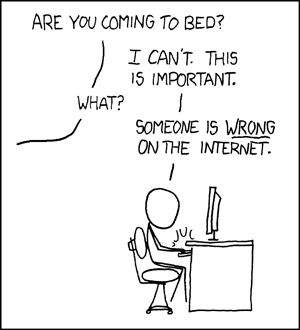
This famous 2008 cartoon from xkcd says it all.

The most important thing to remember when you encounter unpleasantness is: take a breath, verify facts, and don't over-react. As Bob Mayer said on his blog last week: "The internet is a very dangerous place. I’ve seen internet lynch mobs go crazy over the slightest thing (done it myself a time or two) but a day or two of waiting and watching isn’t going to change anything."
When cybermonkeys start tossing verbal feces around a forum or blog, treat it like any other pile of poop.
I didn’t follow that advice recently and I'm still scraping stuff off my shoe.
Absolute Write is no longer recommended. I used to suggest looking there for info on bogus agents and scam publishers. These days, it's so dominated by bitter, bad-tempered snark, you'd probably be safer with the scammers.
Amazon Forums: The Deadwood of the publishing frontier. Brutally anti-author and out of control with vigilantism.
LinkedIn Writers Groups. Some may be safe, but I've unsubscribed from all the ones I belonged to. Way too many rageaholics. LinkedIn is the most invasive of all social media and if you're not on it because of work, I'd recommend you stay away. They'll try to trick you into giving them access to all your email accounts so they can spam every one of your contacts mercilessly in your name, including every agent you've ever queried.
Goodreads: Mean Girls meets Lord of the Flies. This site has been desperately in need of adult supervision for a long time. Recently, they have made big steps in cleaning up the site, but I'd still suggest you stay in safe, author-oriented groups. (I'm fond of my BoomerLit group.) And don't read your reviews!
Or, to be really safe, follow the advice one agent tells her clients: "Go to Goodreads to put up an author profile. Link to your blog. Log out. Never go back."
1) An online product review is nothing like a traditional book review. When most of us think of a book review, we think of something in the New York Times, or a thoughtful assessment of a work written by a sincere blogger who has read the book and done some careful thinking and writing about it.
But online product reviews—as established in the early days of the Internet—are essentially comments, like the comments you see at the end of online news stories or a You Tube entry.
That means some online "reviewers" bear the same resemblance to traditional book reviewers that homicidal baseball fans do to sports commentators: not much.
2) Cruel, angry reviews say more about the reviewer than they do about your book. And they put you in excellent company. I know yours hurt like a physical wound, but it helps to read some of the idiotic one-stars of the classics.
3) It's an urban myth that Amazon requires a certain number of reviews or stars or "likes" on your author page to "move you up the ranks." Only one thing does that: sales.
Some advertising newsletters like Kindle Nation Daily, E-Reader News Today and BookBub do require tons of 5-star reviews, but I think that encourages gaming the system so I use advertisers that don't, like E-Book Bargains UK.
For actual readers, it's much more important to have a few good reviews and some good editorial reviews from well known authors. So don't obsess.
4) A lot of people view retail site reviews as a place for comic relief. Some can be hilarious. Actor George Takei recently made "top reviewer" status on Amazon for his reviews of odd products. I dare you not to laugh.
Others can be morbid and weird, like the Yelp reviews of the hotel where a body was found in the water cistern, or reviews of a wife-killer's "self-help" books.
5) Bad reviews don't always mean bad sales. One young writer engaged in an ill-advised snark battle with an ex that ended up in getting her book over 100 one-star nasty, racist reviews. But her book seems to be selling briskly.
6) Amazon also has an ultra-competitive "top 500/100/50 reviewer" program and you can get caught in their games. According to many reports, Grand Theft Auto mentality is rampant there. Reviewer-on-reviewer bullying and competition can be toxic. I've seen them use review comments and "useful" voting buttons to harass each other. Or they give one-stars to books their rivals love. With the author or vendor getting caught in the middle.
This is obvious breach of Amazon rules, so clicking the "report abuse" button usually solves the problem, but it can be traumatizing for the baffled author.
There is a rigid Amazon review culture and fall afoul of it at your peril. I've just heard of a new book about it called How to Get Good Reviews on Amazon by Theo Rogers, which may explain some more of the arcane rules.
7) Most people who write product reviews and comments are sincere, helpful customers, and some Amazon book reviewers are old school literary experts who could be published in any upscale magazine.
The best way to clean up the review system is add your honest reviews to the mix. Join the ranks of the sincere and helpful!
I know sometimes it seems as if nastiness on the Interwebz is getting worse, but according to some, it's actually turning around. In the May 2013 issue of Esquire, Stephen Marche said: "The Internet has reached peak hate. It had to. At every other moment in history when there has been an explosion of text — whether through social change, like the birth of a religious movement, or technological change, like the advent of print — a period of nasty struggle ensued before the forces of civility reined it in."
Let's hope for those forces of civility to step in soon.
Please don't discuss any specific recent incidents of bullying in the comments, or we'll attract monkey-poo (and if you see it, don't respond. Let it stink for itself.)
But don't keep bullying stories to yourself. Lawyers, law enforcement, and journalists are collecting information and will be grateful for your input. You can leave an incident report for NBC news here. There's more info at the International Bullying Prevention Website.
What about you, scriveners? Do you think Internet can be civilized? What other rules should writers follow to stay safe? Can you recommend other safe places for writers? Know of any other bad neighborhoods we should avoid? Do you think retailers should drop the "star" system on online reviews?

Looking for an editor? Are you an editor? Sign up for GalleyCat's Freelance Editor Directory. As a service to the writers and editors in the GalleyCat audience, they are building a free, automatically updated directory where editors can post their services and writers can seek freelance editors. It's FREE. GalleyCat is one of the top resources in the publishing industry.
Become a Certified Ghostwriter! with the only university level course in ghostwriting. Designed to expand or launch lucrative, professional careers, this course meets online Mondays from 5:30 - 8:30 PM Pacific beginning Oct 14, 2013. Certification at the end of the two semesters is conferred by California State University, Long Beach.
Boomers!! The Huffington Post's Huffpo50 is now publishing short fiction! The rules: You must be 50 or older to enter. Writers can submit only one story per year, and all pieces must be 5,000 words or less. Send your original submissions, as well as your contact details, to 50fiction@huffingtonpost.com.
Get your book international visibility for a reasonable price. EBUK is now advertising bargain books to a dozen countries, including the US and Canada. You can get more info here. Make sure your book is under $3.99 and provide links to all stores, not not only Amazon (unless you're in Select.) Ads are a little over 10 bucks until the end of August. And you can sign up for the newsletter for your country right here. I've signed up for the new US version. If you like bargain ebooks, this is a great free service.
Military Sci Fi Anthology. VFW: Veterans of Future Wars from Martinus Publishing. Write Military stories? Could one of them be set in the future? This is the anthology for you! 2000-6000 words. Make sure to follow submission guidelines. No docx files. Deadline Dec. 31, 2013.
Everybody tells authors we must use social media to have successful careers in the E-age, but nobody talks much about the dangers that lurk here.
Here's the thing: the Internet is still the wild frontier. And it's so huge nobody's quite sure how to police it. Big, loosely regulated social media sites seem to encourage the worst in human behavior. Facebook allows people to make hate pages for celebrities with happy abandon, and the comments on news sites and You Tube can make you want to wash your eyeballs.
You Tube is making some sweeping changes to try to curb some of the more horrifying comments. You'll soon need a Google+ account to log in. (Google+ is set to become the most important player for business in social media. We'll have a post on that in a few weeks.)
Online nastiness is so pervasive that even some literary sites have become more like a jungle full of feces-throwing monkeys than a place for civilized discourse.
Recently, the review site Goodreads (now owned by Amazon) has tried to cut down on the poop-tossing by deleting some ad hominem attack "reviews" and obscene or threatening "shelf" names. Some people decry this as censorship and are protesting by sabotaging Goodreads with thousands of one-star "reviews" on random authors' books.
You can read an overview of the new developments by Pavarti K. Tyler at Indie Reader and Laura Hazard Owen at Gigaom and more at the Passive Voice.
But I fear it will take more than deleting a few reviews to change the online culture of entitlement and emotional brutality.
After I wrote my post on "Gangs of New Media" a few months ago, people contacted me with heartbreaking tales of online bullying in the publishing industry. Authors, readers, and reviewers alike had horror stories.
Respected reviewers had stopped posting to Amazon because of reviewer-on-reviewer attacks and harassment by angry authors. A seasoned Hollywood screenwriter was hounded so mercilessly she had to unpublish her books and change her name. Even a retired army sergeant has been terrified into silence.
But Amazon is trying to crack down, and you can help by reporting abuse when you see it.
Meanwhile, writers need to learn how to avoid gang-infested neighborhoods and stay off the radar of the poop-tossers, bullies, and vigilantes.
Unfortunately marketers sometimes tell us to go into those neighborhoods and do the very things that will set off attacks. I've seen "marketing handbooks" that are the equivalent of sending children into gangland wearing a rival gang's colors.
Part of the problem is that the rules of the online book world bear little resemblance to the conventions of the staid, gentlemanly publishing industry of the past.
That's because the laws of online activity come from the people who were here first: hackers and gamers.
When you enter the online culture, it can feel like stepping into a game of "Grand Theft Auto." It's an aggressive, testosterone-fueled, competitive universe. On some sites, sociopathic behavior is the norm and innocence is a crime.
Everybody is trying to eliminate the enemy, and the enemy is probably you.
"Gaming the system" is a matter of pride for some, and because people tend to judge others' characters by their own, the system-gamers think every innocent newbie is gaming the system too. (If someone accuses everybody he meets of sneaky, underhanded dealings, he's revealing a lot about himself.)
Probably the most infamous Internet menace was the sociopath called Violentacrez, who slimed up the forums of Reddit with threats and hate speech masked as "categories" with names like "chokeabitch" that were technically within site guidelines, but invited misogynist rants, child pornography and hate.
We can't blame the Internet entirely for the phenomenon. These are the same people who 40 years ago would name their dogs a racial slur and claim to be "just calling the dog." If anybody objected, they'd rally a mob to beat up the "puppy hater."
Violentacrez was finally outed by Gawker last year, but thousands of his trollish kin remain—and plenty of them lurk under literary bridges.
So don't give them an excuse to terrorize you. Follow the rules. Nobody deserves to be bullied, but you're safer if the bullies don't notice you.
Remember: social media should not be used for direct marketing. It should be used for making friends. You wouldn't wear an advertising sandwich board to a Chamber of Commerce mixer, but a lot of authors are doing the digital equivalent. It makes them bully-bait.
If the bullies catch you breaking their rules—even unwritten ones—they will destroy your career and reputation with all the self-righteous sadism of the Taliban slaughtering a schoolgirl.
Unfortunately, ferreting out those rules can be daunting. Even when they're posted, they're usually obfuscated by legal jargon written in a fly-speck font. I've only learned the following by trial and error. Lots of error. When I wrote this post urging older people to learn to write Amazon reviews, I was pretty naive. I still urge readers of my generation to write reviews—this is a culture desperately in need of grown-ups—but if I'd known about the hostility of the review culture, I would have worded it more carefully.
Since then, I've been saying, "I wish somebody would post the rules!"
But hey, nobody has, so here they are—as well as I can figure out. Pass them on to your marketing department.
Rule #1 Never Spam
Easy to say; harder to follow.
What is spam? It's unwanted promotion: the digital equivalent of those sales pitch phone calls you get just as you're sitting down to a family dinner.
But one person's spam is another person's "savvy marketing." One of our biggest problems is that spam is defined differently depending on where you are.
Here's a detailed post on how NOT to spam on specific sites like Facebook, Twitter, Goodreads, forums, etc.
A few authors have spammed and gamed the system so badly that we're all paying the price.
Some readers have reacted so negatively they've invented a bizarre dichotomy of readers vs. writers. They consider anybody who writes to be the mortal enemy of "readers." Don't ask me where they think reading material comes from. A Magical Book Stork in the Sky may be involved.
Of course, in real life, authors are voracious readers, but remember this is a videogame world, so they need an enemy.
Mention you've written a book—even an unpublished one—and that enemy is you.
Rule #2: Never Trade Reviews
It's against Amazon's terms of service. A violation can get you kicked off Amazon. It will certainly get your reviews pulled if you're caught.
One of the tricks of the early Amazon-gaming authors was to give a book a 5-star review, then contact the reviewed author and demand a 5-star in return. If the targeted author refused, the 5-star would be reduced to a one-star.
Not all trading of reviews is the result of blackmail. Lots of authors drop hints they expect a quid pro quo when they've written a good review. Do not fall into this trap. Even if you love the reviewer's book, you could be violating Amazon's TOS.
One of Amazon's rules is that you can't review a product if you will benefit from the proceeds. That's why your Mom can't give you a review. Or your editor. You also can't review if you have a "rival" product. This has been interpreted recently to mean "any author who writes in the same genre"—even if that review is positive. I think that's silly, but it's best to be safe.
In the great Amazon review purge following the purchased-review scandal of 2012, thousands of reviews were removed, some of which were solid, honest reviews, so you need to avoid any hint of impropriety. If you love the book of an author in your genre who has given you a nice review, and you want to avoid any worries, give her a spotlight or interview on your blog or offer a blurb to be included in the "editorial reviews" instead of appearing to trade.
Update: South African author Niki Savage reports that an Amazon spokesperson told her the Zon has revoked the rule that authors can't review other authors in their genre! I don't know if this applies to the Zon worldwide, but if you've been dying to review a book in your favorite genre, go for it!
Rule #3: Don't Pay for Customer Reviews
It's OK to pay for a professional review from Kirkus, Publisher's Weekly, or other respected publication like the Midwest Book Review. But those reviews can't be posted on Amazon as "customer reviews." You can paste a quote into the "editorial reviews" section. But a customer review is not supposed to be for sale.
Even a free book is considered "payment" by some, so book review bloggers are now required to post disclaimers when they review a book they have received from the author or publisher, although free review copies have always been a standard practice in the industry.
(Recently a blogpost was circulating that accused pretty much every major indie author of purchasing 500+ book reviews from Fivrr. This was a nasty hoax. Some of the authors accused don't even have 500 reviews on all their books combined.)
Rule #4 Never Respond to Your Reviews
On places like Goodreads, people will call you a "badly behaving author" simply for thanking a thoughtful reviewer for a good review.
What you can do when you get a fantastic review is follow the reviewer on other social media and hope they'll initiate contact. Several of my reviewers have become good friends because I friended them on Facebook. But resist the urge to say "thank you" in the comments of the review itself. I did this myself before I knew the rules, with no bad consequences, but you never know when a vigilante might be lurking. (I'm only talking about review sites here: not blogs. Most bloggers welcome a thank-you for a nice review.)
But especially don't comment on nasty reviews. You're inviting more abuse.
Here are a few facts about reviews that may help to keep your fingers off the keyboard when the nasties hit:
1) Online review sites do not require reviewers to read a book and often allow people to rate a product even before it's available to anyone. This is a convention of the gaming world. It's something videogame companies did in the early days to gauge interest in a new game. Now, unfortunately, it's become a convention in online bookselling.
There's nothing we can do but spread the word that those star ratings don't mean a thing. I wish they'd drop them.
Why do people write nasty, hateful reviews of books they haven't read? Because being nasty and hateful is what they do. A new study says haters really gotta hate. Be glad they're on your book page and not in your living room.
2) One of the most common nasties is the "I hate this genre" review. I've seen plenty of review pages by people who apparently do nothing but troll Amazon for books in genres they hate so they can write one star reviews. Unfortunately, they have that right.
3) Bestsellers pretty much always get snarky reviews. So accept it as a mark of success. Sometimes they're from sour-grape wannabes and sometimes from sock puppets. (Those are other authors with fake id's trying to get you "out of the way.") But sock puppetry is hard to prove. If the person has no other reviews and mentions a "rival" book, report abuse and hope the Zon elves will give you a hearing.
4) Free books are magnets for cruel reviews. It's one of the reasons free books aren't working as well as they used to.
Give-aways of free paper review copies on Goodreads and other book sites are being gamed. Every day I see authors complain that their expensive review copies are immediately sold on Amazon as "new" and they get no review, or worse, a one-sentence one-star.
So I advise that authors only send paper review copies to established bloggers and reviewers they have a prior relationship with.
NOTE: Always query a book review blogger before sending a review copy and for goodness' sake, READ THE BLOG—why is that so hard? Publicists: I'm talking to you.
5) Luckily, your readers can usually spot a troll review and nice people may even buy the book because of it.
And guess what? There really are a lot more nice people than nasty ones. One way to fight all this is to be one of the good guys. Writing honest reviews of books you like is the best way to fight this behavior.
Rule # 5: Always Report Abuse (and take a screenshot)
These crimes are new—and span continents—but when a few sociopaths interfere with the bottom line of multinational corporations, you can be sure somebody's going to figure out how to control them.
That may result in restricted freedom for us all, so cutting down on it now is in everybody's interest. That's why you need to report abuse whenever you see it.
Okay, what's a screenshot? If you're a Boomer like Ruth and me, you may not know much about them.
But it turns out there's a way to take a photo of what's on your screen. I could really have used it when I witnessed some abuse recently. But since then, I've found this great thing called Awesome Screenshot that puts a button right on your toolbar. You just click on that button and, voila! You can capture the whole page, the visible part or a partial. You can even make red circles around the pertinent spots.
Note: a negative, snarky review is not abuse. A review that's obscene, threatening, or attacks the author personally is. So is an ad for another author's book or services.
So you have to live with a review that says:
"This wud be the wurst buk i ever red, if i wudda red it."
But you can report one that says:
"This author is a cyberslut-boy who gay-sexted with Anthony Weiner."
or
"Somebody should #%&*@#!@$&*%!!! you sidewayswith a %*&@#!!!"
or
"This book is soooo boring. My erotic romance FIFTY SHADES OF DRYING PAINT is much more exciting. Here's the link."
A barrage of One-star personal attacks, called "swarming" can usually be removed. Character assassination by "review" is one of the more heinous misuses of Amazon and Goodreads.
To report abuse:
1) On FaceBook there's a little downward-arrow to the right of the post that will bring up a menu. One of the possible selections is "report abuse." Unfortunately the trolls have found it too, and they love to report people for abuse when they haven't done anything. But if that happens, you can write to appeals@facebook.com.
2) On Twitter Click on "***more" in the lower right corner of the tweet. This brings up a menu for "share", "embed" or "report". "Report" brings up a new menu where you can simply block, mark as spam, "compromised" (for when your Tweep has been hacked) or "abusive". "Abusive" brings up a form to fill out. It's more hoop jumping than they used to require, but that's to prevent trolls from reporting random innocents for abuse, as has been happening on FB.
3) On Amazon there's a prominent button for reporting abuse. Use it especially if you see abuse on another author's page. Amazon will pay more attention if it's from somebody other than the victim.
4) On Goodreads the button for "flagging" abuse is harder to find, but this post by friend of the blog Lexa Cain will tell you how. Also report abuse to the administrators via support@goodreads.com. Goodreads has tolerated rampant abuse of their review and "shelving" system for a long time. But now they're trying to clean up their act, so they will pay attention to your reports.
Even if you don't see an immediate result, things are probably happening behind the scenes. Site admin. usually pays attention to abuse reports only after they get a lot. So report.
This just in. Some of the info I have here is wrong. We DON'T have to live with misleading reviews. Here's an enlightening addition from attorney Janet Normalvanbruecher,a practicing attorney with a sub-speciality in intellectual property law.
"Just because a multi-national corporation willfully breaks the law does not mean it is legal!
SELLERS HAVE AN AFFIRMATIVE DUTY TO ENSURE ANY CUSTOMER TESTIMONIAL THEY USE TO SELL PRODUCTS IS TRUE
I will list links to the relevant legal statutes, government agencies, and news sources so your readers know they DO have recourse.
1. Online customer reviews are a form of 'endorsement' or 'customer testimonial.'
REF: Federal Trade Commission overview video - http://www.business.ftc.gov/multimedia/videos/ftc-endorsement-guides
(Note: due to the government shutdown you can't access this video until the trolls in congress stop bickering ... but it's excellent).
2. This doesn't just apply to online bloggers, but ANY distributor (seller) or other website that makes their money selling third-party review data to create sales. The operative word is 'commerce.' It has to somehow involve money.
REF: Federal Trade Commission Guides Concerning the Use of Endorsements and Testimonials in Advertising (this link is not effected by the gov't shutdown):
http://ftc.gov/os/2009/10/091005revisedendorsementguides.pdf
3. Attorney generals nationwide are beginning to crack down on fraudulent third-party review sites such as YELP who rates hotels and restaurants much the way Goodreads reviews books:
REF: http://www.nbcnews.com/business/ny-attorney-general-cracks-down-fake-online-reviews-4B11235875
4. If you believe a review is false, you can file a complaint with these Federal Agencies (note: due to the shutdown you may need to wait until congress finishes bickering):
a. The Federal Trade Commission: www.ftccomplaintassistant.gov
b. The Better Business Bureau: https://www.bbb.org/consumer-complaints/file-a-complaint/get-started
c. Your local state attorney general's office:
Google: YOUR STATE + ATTORNEY GENERAL CONSUMER AFFAIRS DIVISION + FILE COMPLAINT
There are also ways to track the IP address of people who post a comment on a blog and then drag them into court to personally sue them, but right now the government is beginning to get interested in how big multinational internet sellers such as Amazon and big multinational internet rating sites such as Goodreads are gaming the system, so I recommend you file a complaint with THEM. It takes HUNDREDS of complaints to get the government to stick their nose into something, but as you can see from the New York AG/YELP scandal, eventually they usually do.
To tie it up ... do as Anne recommends ... avoid troll havens ... never comment on a review ... quietly report the troll-dung and walk away ... but PLEASE take the next step and also file complaints with the appropriate government agencies, not just the media. The media is not always sympathetic to authors.
The government, on the other hand, is very interested in how powerful Amazon and its sub-rating sites have become. Tie it to MONEY (lost sales), not fairness, and eventually the government will get off it's backside and bite back the trolls FOR you." ...Janet Normalvanbruecher
Rule #6: Never Argue with a Drunk or a Fool
Internet bullies are both. They are literally drunk on their own rage. Rage can trigger endorphins that create a high similar to cocaine or meth.
How far do you think you'd get using reason and logic with a crazed tweaker on the street? Right. Then don't try it on the Internet. Even if they are wrong. Because guess what? They almost always are.
This famous 2008 cartoon from xkcd says it all.
The most important thing to remember when you encounter unpleasantness is: take a breath, verify facts, and don't over-react. As Bob Mayer said on his blog last week: "The internet is a very dangerous place. I’ve seen internet lynch mobs go crazy over the slightest thing (done it myself a time or two) but a day or two of waiting and watching isn’t going to change anything."
When cybermonkeys start tossing verbal feces around a forum or blog, treat it like any other pile of poop.
- Carefully walk around it.
- Realize you don't have to tell anybody what it is. Its stink will give it away.
- Call maintenance.
- Go someplace cleaner.
I didn’t follow that advice recently and I'm still scraping stuff off my shoe.
Rule #7 Stay Out of Rough Neighborhoods
Absolute Write is no longer recommended. I used to suggest looking there for info on bogus agents and scam publishers. These days, it's so dominated by bitter, bad-tempered snark, you'd probably be safer with the scammers.
Amazon Forums: The Deadwood of the publishing frontier. Brutally anti-author and out of control with vigilantism.
LinkedIn Writers Groups. Some may be safe, but I've unsubscribed from all the ones I belonged to. Way too many rageaholics. LinkedIn is the most invasive of all social media and if you're not on it because of work, I'd recommend you stay away. They'll try to trick you into giving them access to all your email accounts so they can spam every one of your contacts mercilessly in your name, including every agent you've ever queried.
Goodreads: Mean Girls meets Lord of the Flies. This site has been desperately in need of adult supervision for a long time. Recently, they have made big steps in cleaning up the site, but I'd still suggest you stay in safe, author-oriented groups. (I'm fond of my BoomerLit group.) And don't read your reviews!
Or, to be really safe, follow the advice one agent tells her clients: "Go to Goodreads to put up an author profile. Link to your blog. Log out. Never go back."
Rule #8: Change your definition of "review" and don't take online reviews so seriously
1) An online product review is nothing like a traditional book review. When most of us think of a book review, we think of something in the New York Times, or a thoughtful assessment of a work written by a sincere blogger who has read the book and done some careful thinking and writing about it.
But online product reviews—as established in the early days of the Internet—are essentially comments, like the comments you see at the end of online news stories or a You Tube entry.
That means some online "reviewers" bear the same resemblance to traditional book reviewers that homicidal baseball fans do to sports commentators: not much.
2) Cruel, angry reviews say more about the reviewer than they do about your book. And they put you in excellent company. I know yours hurt like a physical wound, but it helps to read some of the idiotic one-stars of the classics.
Some advertising newsletters like Kindle Nation Daily, E-Reader News Today and BookBub do require tons of 5-star reviews, but I think that encourages gaming the system so I use advertisers that don't, like E-Book Bargains UK.
For actual readers, it's much more important to have a few good reviews and some good editorial reviews from well known authors. So don't obsess.
4) A lot of people view retail site reviews as a place for comic relief. Some can be hilarious. Actor George Takei recently made "top reviewer" status on Amazon for his reviews of odd products. I dare you not to laugh.
Others can be morbid and weird, like the Yelp reviews of the hotel where a body was found in the water cistern, or reviews of a wife-killer's "self-help" books.
5) Bad reviews don't always mean bad sales. One young writer engaged in an ill-advised snark battle with an ex that ended up in getting her book over 100 one-star nasty, racist reviews. But her book seems to be selling briskly.
6) Amazon also has an ultra-competitive "top 500/100/50 reviewer" program and you can get caught in their games. According to many reports, Grand Theft Auto mentality is rampant there. Reviewer-on-reviewer bullying and competition can be toxic. I've seen them use review comments and "useful" voting buttons to harass each other. Or they give one-stars to books their rivals love. With the author or vendor getting caught in the middle.
This is obvious breach of Amazon rules, so clicking the "report abuse" button usually solves the problem, but it can be traumatizing for the baffled author.
There is a rigid Amazon review culture and fall afoul of it at your peril. I've just heard of a new book about it called How to Get Good Reviews on Amazon by Theo Rogers, which may explain some more of the arcane rules.
7) Most people who write product reviews and comments are sincere, helpful customers, and some Amazon book reviewers are old school literary experts who could be published in any upscale magazine.
The best way to clean up the review system is add your honest reviews to the mix. Join the ranks of the sincere and helpful!
I know sometimes it seems as if nastiness on the Interwebz is getting worse, but according to some, it's actually turning around. In the May 2013 issue of Esquire, Stephen Marche said: "The Internet has reached peak hate. It had to. At every other moment in history when there has been an explosion of text — whether through social change, like the birth of a religious movement, or technological change, like the advent of print — a period of nasty struggle ensued before the forces of civility reined it in."
Let's hope for those forces of civility to step in soon.
***
Please don't discuss any specific recent incidents of bullying in the comments, or we'll attract monkey-poo (and if you see it, don't respond. Let it stink for itself.)
But don't keep bullying stories to yourself. Lawyers, law enforcement, and journalists are collecting information and will be grateful for your input. You can leave an incident report for NBC news here. There's more info at the International Bullying Prevention Website.
What about you, scriveners? Do you think Internet can be civilized? What other rules should writers follow to stay safe? Can you recommend other safe places for writers? Know of any other bad neighborhoods we should avoid? Do you think retailers should drop the "star" system on online reviews?
Book Bargain of the Week
Food of Love: a comic thriller about dieting, chocolate, and a small nuclear bomb.
Part thriller and part screwball romantic comedy, Food of Love is a rollercoaster comedy that also addresses complex issues about body image, religion and a woman's right to choose.

"This hilarious page-turner packs a profound satirical bite. It's a Hollywood romp that provides romance, mystery, and an honest confrontation with the human condition. Food of Love is a funny and powerfully healing book." ...Lucia Capacchione, PhD, bestselling self-help author, Recovery of Your Inner Child
Opportunity Alerts
Looking for an editor? Are you an editor? Sign up for GalleyCat's Freelance Editor Directory. As a service to the writers and editors in the GalleyCat audience, they are building a free, automatically updated directory where editors can post their services and writers can seek freelance editors. It's FREE. GalleyCat is one of the top resources in the publishing industry.
Become a Certified Ghostwriter! with the only university level course in ghostwriting. Designed to expand or launch lucrative, professional careers, this course meets online Mondays from 5:30 - 8:30 PM Pacific beginning Oct 14, 2013. Certification at the end of the two semesters is conferred by California State University, Long Beach.
Boomers!! The Huffington Post's Huffpo50 is now publishing short fiction! The rules: You must be 50 or older to enter. Writers can submit only one story per year, and all pieces must be 5,000 words or less. Send your original submissions, as well as your contact details, to 50fiction@huffingtonpost.com.
Get your book international visibility for a reasonable price. EBUK is now advertising bargain books to a dozen countries, including the US and Canada. You can get more info here. Make sure your book is under $3.99 and provide links to all stores, not not only Amazon (unless you're in Select.) Ads are a little over 10 bucks until the end of August. And you can sign up for the newsletter for your country right here. I've signed up for the new US version. If you like bargain ebooks, this is a great free service.
Military Sci Fi Anthology. VFW: Veterans of Future Wars from Martinus Publishing. Write Military stories? Could one of them be set in the future? This is the anthology for you! 2000-6000 words. Make sure to follow submission guidelines. No docx files. Deadline Dec. 31, 2013.
***
This month Anne has an article about the pressures social media puts on authors at Talking Writing, the magazine for creative writers and readers.
.jpg)

.jpg)


